Inside the X-59: The Human Work Behind Quiet Supersonic Flight
A mechanic’s headfirst inspection of NASA’s X-59 reveals the demanding maintenance behind an aircraft built to reshape the sound of supersonic flight. The routine check also highlights why people remain essential in an increasingly instrumented test program.
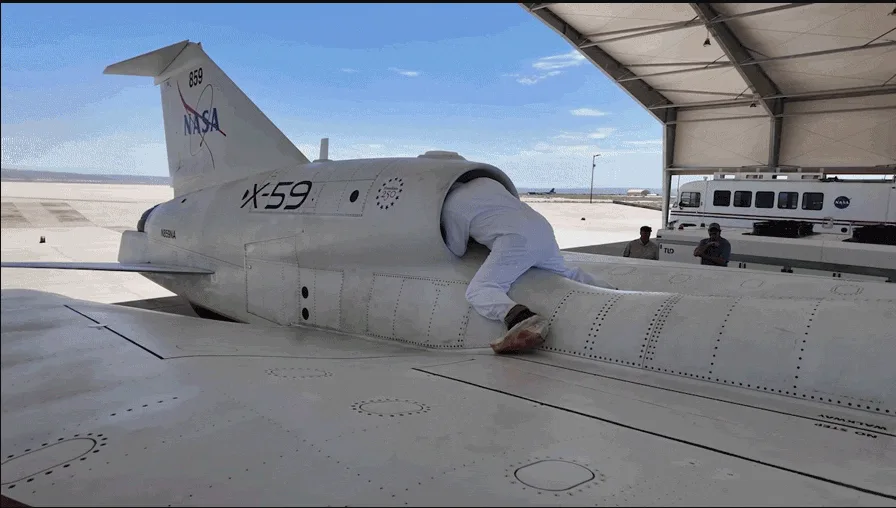
A striking maintenance scene unfolded in the California desert in spring 2026, when NASA’s X-59 was resting between its 11th and 12th flights. Mechanic Jonathan Reynaga climbed onto the aircraft, walked along its wing and disappeared headfirst into the inlet feeding its single engine.
NASA Blogs reported the episode on Friday, October 16. The inspection took place at NASA’s Armstrong Flight Research Center in Edwards, California, where crews were supporting the flight-test phase of the agency’s Quesst mission.
To an observer, the maneuver could have looked improvised. In research aviation, however, “duct diving” is an established way to examine areas that cameras or an external walkaround may not fully reveal. The immediate goal is to find foreign objects, physical damage or anything else that could degrade engine performance.
The X-59 presents its own ergonomic challenge. Its inlet slopes toward the engine, forcing an inspector to enter with the head below the feet. Reynaga, a general flight mechanic employed by X-59 contractor Lockheed Martin Skunk Works, had only a little more than shoulder width in which to maneuver.
Using a flashlight, he checked the engine fan blades and other visible parts of the flow path. He also had to negotiate the specialized sensors installed for the research program. Those instruments gather performance data, but their presence means a technician must avoid disturbing the very equipment that helps engineers understand the propulsion system.
The dive lasted only a few minutes. Reynaga then backed out of the inlet while another crew member monitored him. The observer was not merely assisting with the exit: confined access, an inverted posture and intense heat make continuous supervision an important safeguard.
Desert conditions add a second layer of difficulty. Although the X-59 was kept in shade during maintenance, temperatures at Edwards can exceed 100 degrees Fahrenheit, or roughly 38 degrees Celsius. The aircraft itself was also shedding heat from its flight while technicians began their work.
This rapid inspection was not a substitute for scheduled, in-depth maintenance. Rather, crews paired a duct dive with a visual examination of the exhaust after each flight to obtain a prompt indication of engine health. The practice gives maintainers a direct view before the aircraft moves further through the test sequence.
Armstrong personnel use the same basic technique on other research jets, including aircraft that accompanied the X-59 during testing. An F-15 has deep, rectangular inlets with enough room for a person to crawl relatively comfortably. An F/A-18 offers a less forgiving combination of narrow diameter, curvature and limited working space.
The X-59 inlet falls somewhere between those experiences. Juan Salazar, crew chief for NASA’s Low Boom Flight Demonstrator project, described it as similar in diameter to the F/A-18 inlet but shallower, making entry somewhat easier. Even so, the inspection depended on a person’s mobility, judgment and ability to recognize subtle abnormalities at close range.
Salazar acknowledged that another technology might eventually replace this kind of human examination. The account did not identify a system ready to do so, however, and the crew’s view was that sending a trained mechanic remained the best available method. That conclusion underscores a broader feature of flight research: sophisticated sensors do not eliminate the value of direct physical inspection.
The inlet’s location is tied to the central purpose of the X-59. Mounting the engine on top helps the aircraft keep its supersonic shock waves from combining in the way they do behind conventional designs. Instead of producing the familiar loud sonic boom at ground level, the experimental aircraft is intended to create a much quieter sonic thump.
A top-mounted inlet has a maintenance advantage as well, because it is less exposed to debris that lower engines may ingest during takeoff or landing. By the time NASA published its account, the X-59 had completed 38 flights, and its duct inspections had found an engine free of damage. The result described conditions through that point in the campaign, while the repeated checks illustrated the caution required to sustain an experimental aircraft through flight testing.