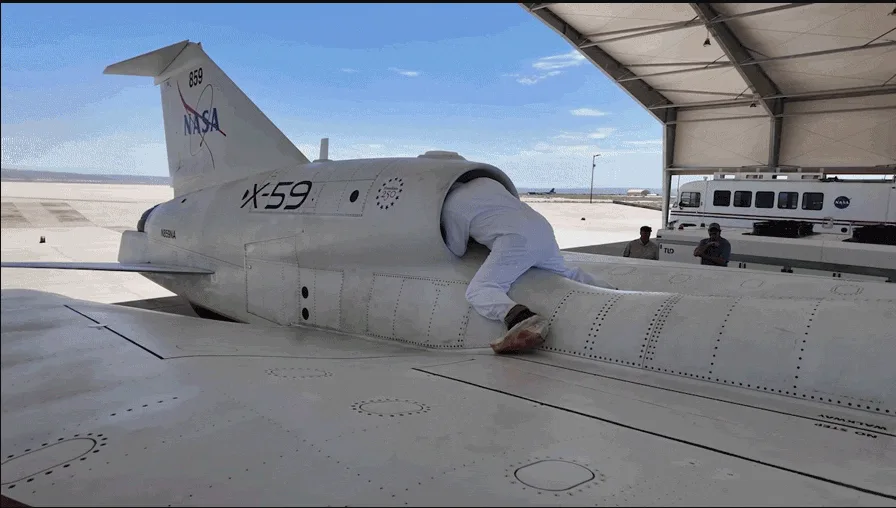
X-59’s first-flight pilot earns Kincheloe Award
NASA test pilot Nils Larson was honored for guiding the X-59 through its maiden flight and safely extending its envelope to Mach 1.4 at 55,000 feet. The award marked the first recognition of a NASA flight-test project in 44 years.
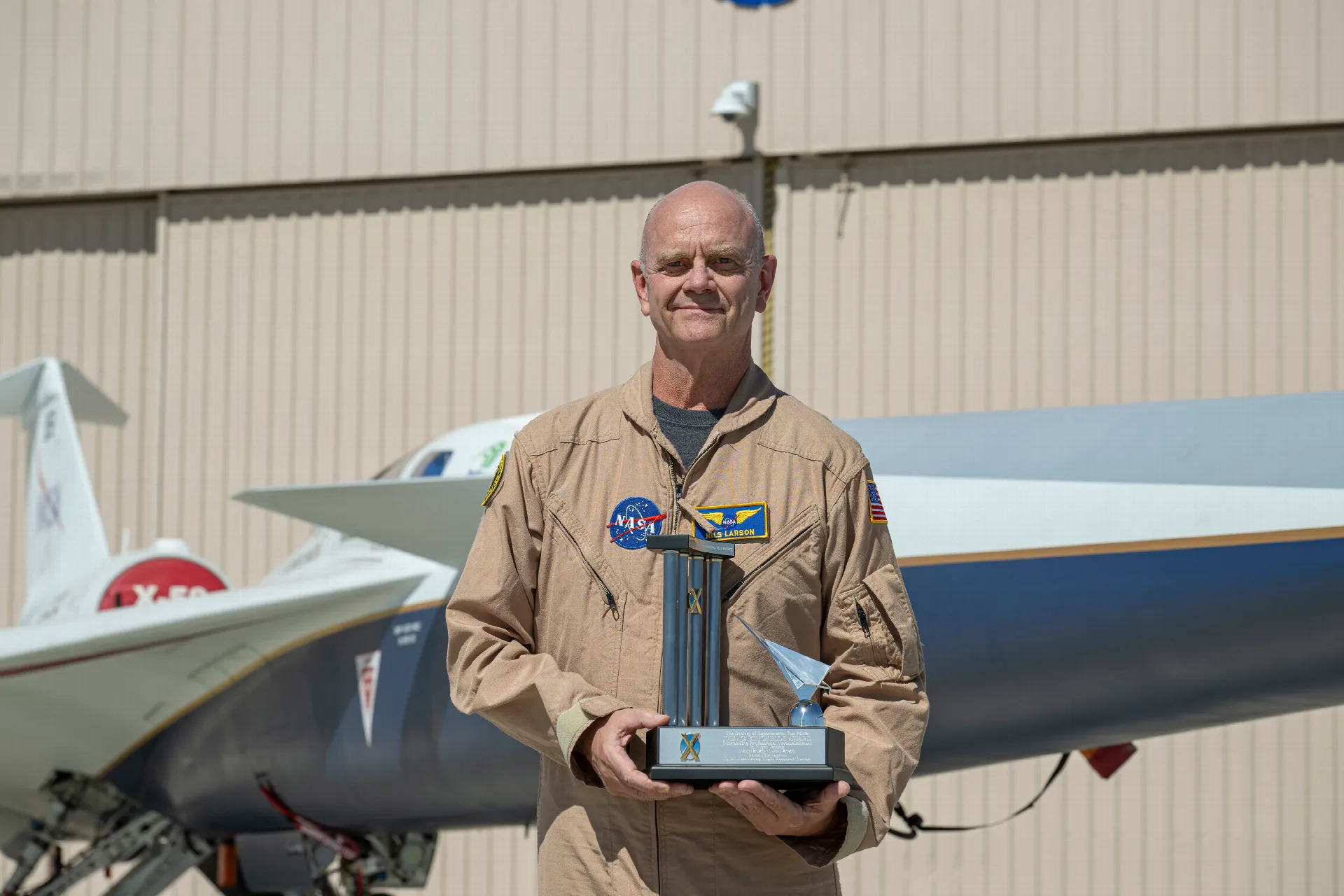
The first flight of an experimental aircraft is a visible milestone, but it is only one part of a much longer test campaign. For NASA pilot Nils Larson, the X-59’s 2025 debut was followed by a deliberate expansion of the aircraft’s operating envelope, ultimately reaching Mach 1.4 at an altitude of 55,000 feet.
NASA Blogs reported the recognition on Friday, October 9. Larson had received the Society of Experimental Test Pilots’ Iven C. Kincheloe Award on September 26, placing the honor before both the agency’s post and the present review of the program.
The society cited Larson’s leadership during the maiden flight and the safe progression into more demanding flight conditions. He became the first person in 44 years to receive the award for work on a NASA flight-test project, giving the distinction an institutional significance beyond the individual achievement.
A flight envelope describes the combinations of speed, altitude and other conditions in which an aircraft is evaluated and operated. Expanding it is normally incremental: engineers and pilots review results from one stage before approving the next. In the X-59 campaign, the reported benchmark of Mach 1.4 at 55,000 feet demonstrated how far that process had advanced by the time of the award.
Larson’s contribution began well before he took the aircraft into the air. NASA credited him with helping shape the research and simulations used in the X-59’s development. That involvement connected cockpit experience with the analytical work intended to anticipate aircraft behavior before a pilot confronted it in actual flight.
The role of a test pilot in such a program therefore extends beyond handling the controls. Pilot observations must be compared with instrumentation, engineering predictions and rehearsed procedures. The Kincheloe Award recognized this combination of operational judgment, technical participation and responsibility for safely exploring a new aircraft’s capabilities.
Larson has shared flying duties with NASA pilot Jim “Clue” Less as the agency has operated the X-59 across a variety of speeds, altitudes and conditions. Alternating pilots broadens the program’s operational experience and places the flight work within a team structure rather than treating it as a single aviator’s undertaking.
The aircraft is the centerpiece of NASA’s Quesst mission, which is aimed at advancing the prospect of quieter commercial supersonic travel over land. Its purpose differs from a straightforward attempt to set a speed record: the research focuses on how a specially shaped aircraft can alter the acoustic effects associated with supersonic flight.
That acoustic question has long been central to the practical limits on civil supersonic operations. Aircraft traveling faster than sound generate pressure waves that can be heard on the ground as sonic booms. Quesst is intended to support research into a quieter experience, while the flight campaign supplies the real-world conditions needed to study the concept.
The award does not, by itself, mean commercial quiet-supersonic service has begun or that rules governing overland flight have changed. NASA’s account described Larson and Less as advancing the agency’s goals toward enabling such operations. It presented the X-59 effort as continuing research rather than a completed commercial or regulatory transition.
The 44-year interval since a NASA test-flight project last produced a Kincheloe recipient also highlights the rarity of the recognition. In this case, the society honored a sequence of achievements: preparation of the research framework, execution of the first flight and controlled movement into supersonic test points.
NASA’s October 9 account did not declare the broader Quesst mission complete. It described ongoing flights under varying conditions and directed readers to the mission’s materials for further information. Larson’s award thus marked a completed and measurable phase of the work while the larger investigation of the X-59 and quiet supersonic flight continued.