
NEO Surveyor’s Sunshade Moves Closer to Flight Form
NASA’s asteroid-hunting spacecraft has reached a significant hardware milestone with the integration and testing of solar cells on its towering sunshade. The component will both power the observatory and protect its infrared telescope from solar glare.
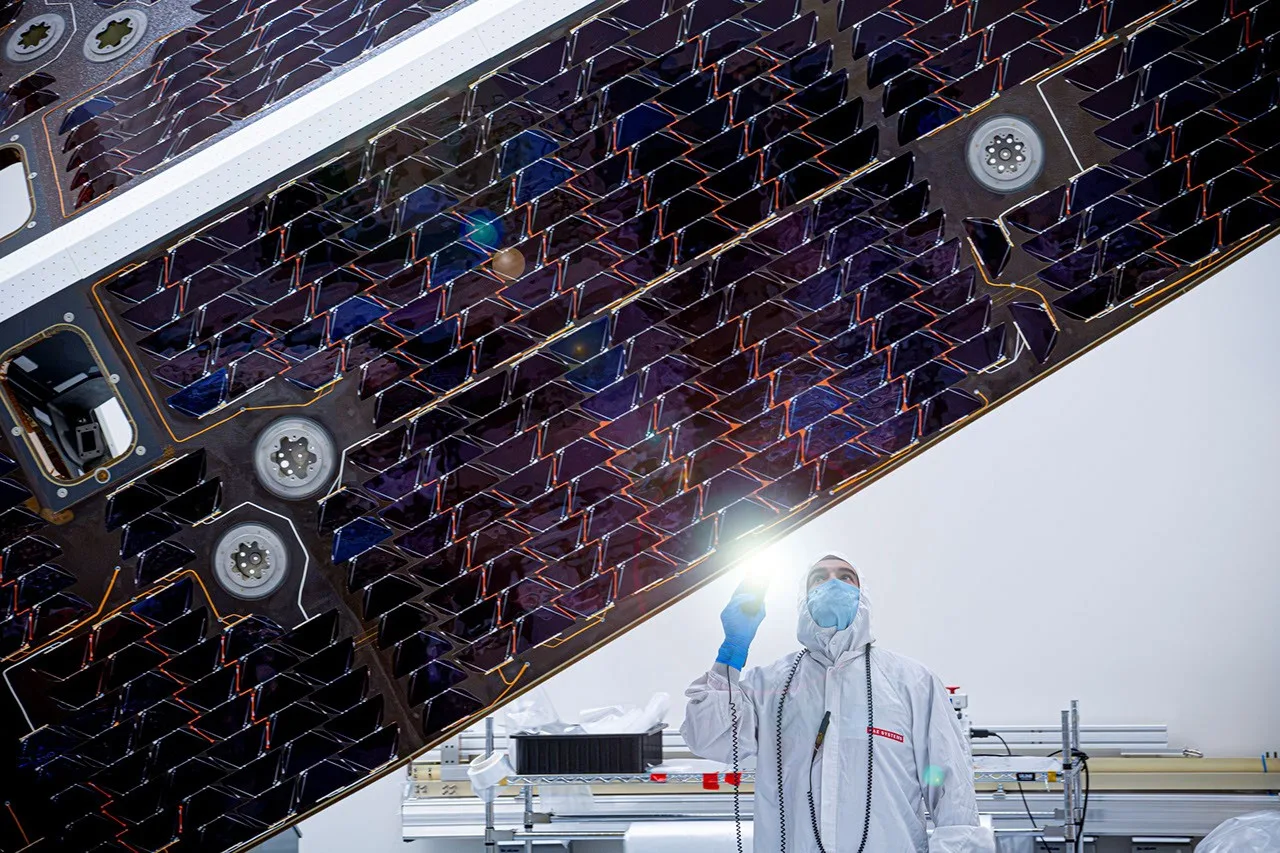
The largest structure on NASA’s NEO Surveyor spacecraft is taking on its flight-like form after teams integrated and tested its solar array. The 20-foot-tall sunshade is central to the mission’s design because it must serve simultaneously as an optical barrier, a thermal shield, and the spacecraft’s source of electrical power.
NASA Blogs reported the development on Monday, October 26. According to the agency’s account, work on the solar array included functional and performance testing after the installation of additional sensors needed to monitor temperature and help determine the spacecraft’s orientation relative to the Sun.
The sunshade stands about 6 meters tall and measures 8 feet, or 2.4 meters, across its base. It consists of two flat panels joined at an angle of 23.5 degrees. Rather than being a conventional accessory attached to the observatory, the structure is an integral part of the conditions under which the infrared telescope can make useful measurements.
Earlier in 2026, the two panels were covered with 864 interconnected solar cells. Together, they form a specialized array capable of producing as much as 2 kilowatts of power. That output is intended to supply all the electricity required to charge the spacecraft’s onboard batteries, which in turn will operate its instruments and supporting systems.
The dual use of the structure reflects one of the mission’s fundamental engineering challenges. NEO Surveyor needs sunlight to power its systems, yet direct solar glare and heat would interfere with the sensitive infrared observations at the heart of the project. The sunshade is therefore designed to collect solar energy on one side while maintaining a protected environment for the telescope.
NEO Surveyor is intended to search for near-Earth asteroids and comets, including objects appearing in parts of the sky toward the Sun. Those areas are difficult for ground-based optical observatories to examine because bright sunlight limits when and how effectively they can look close to the solar direction. Some of the objects sought by the mission are consequently among the hardest members of the near-Earth population to find.
The shield will prevent sunlight from entering the telescope’s 20-inch, or 50-centimeter, aperture. With the glare blocked and the instrument kept cool, the observatory can look for infrared energy emitted by the sun-warmed surfaces of asteroids and comets. The method gives the spacecraft a different basis for detection than visible-light surveys that primarily measure reflected sunlight.
At the focal plane, a pair of infrared detector arrays will image the sky in two wavelength bands. Each detector array is designed to create a 16-megapixel mosaic. Observing the same field in both bands will allow researchers to compare the infrared signal and derive an object’s temperature rather than simply recording its apparent position.
Temperature is valuable because it supports an estimate of an asteroid’s or comet’s physical size. Size is a critical element in assessing a near-Earth object, while repeated observations of its position establish how it is moving through space. Taken together, these measurements are expected to improve NASA’s understanding of the number and characteristics of potentially hazardous near-Earth objects.
Production and preparation of the sunshade have involved facilities in several parts of the United States. Applied Aerospace built the primary structure in Stockton, California. SolAero Technologies installed the solar cells in Albuquerque, New Mexico, in January 2026, turning the large shield into the spacecraft’s power-generating surface.
In March, the combined sunshade and array underwent environmental testing at a commercial thermal-vacuum facility in El Segundo, California. The component was then delivered ahead of schedule in May to BAE Systems Space & Mission Systems in Boulder, Colorado. The sequence moved the hardware from fabrication through simulated space-environment checks and into a further phase of spacecraft integration.
Teams subsequently added coarse Sun sensors used for attitude determination, along with temperature sensors, before completing the array’s functional and performance tests. The source account did not specify a launch date, but the milestone shows how several mission requirements converge in a single piece of hardware: electrical generation, thermal control, sunlight exclusion, and support for an infrared survey designed to reveal difficult-to-detect objects near Earth.