
ISS Crew Combines Bioprinting with Spacewalk Preparations
Expedition 75 astronauts carried out vascular tissue printing, spacesuit checks, robotics practice and Earth imaging during a tightly coordinated orbital workday. The preparations also supported a spacewalk scheduled for October 29 to install a roll-out solar array.
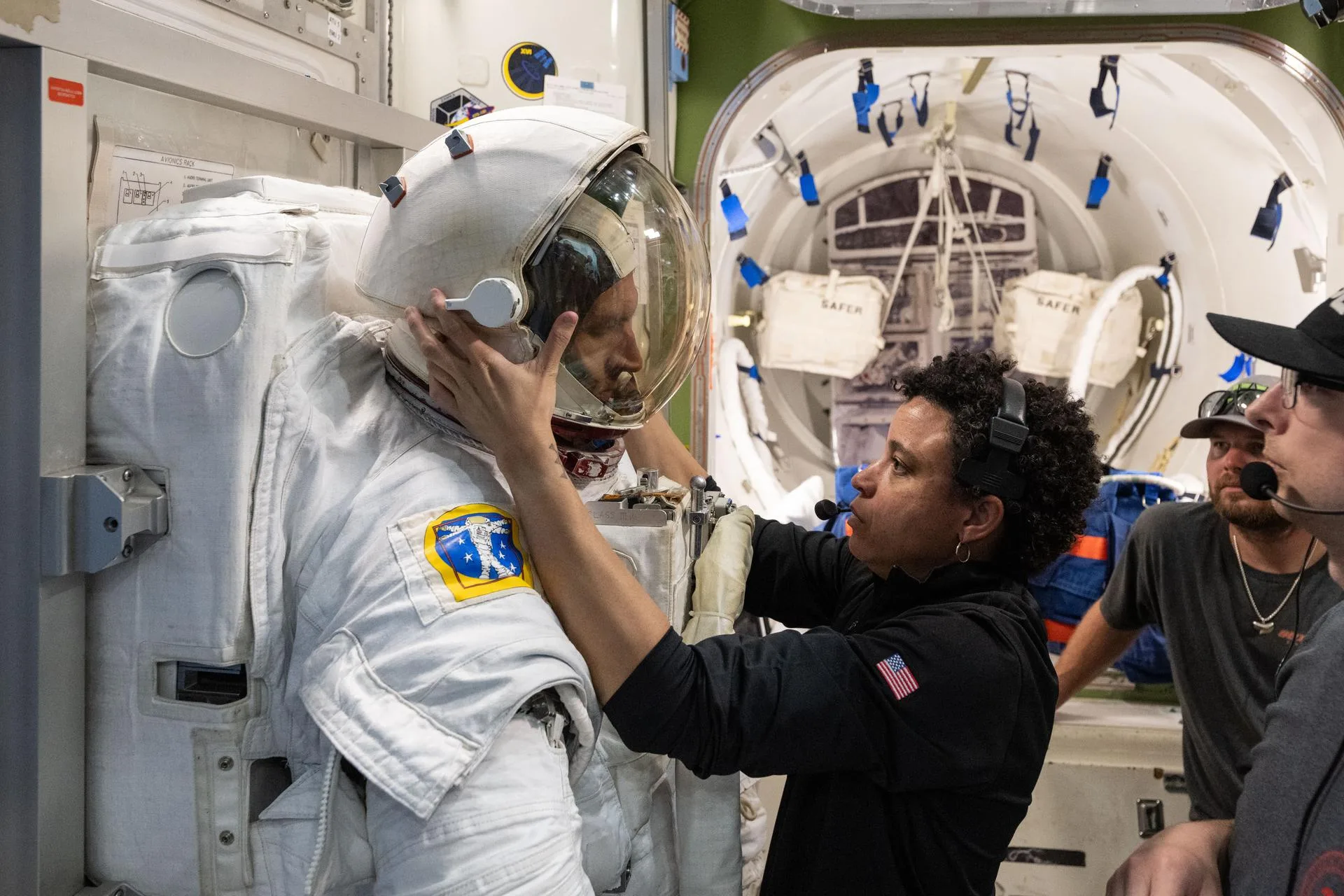
Expedition 75 crew members moved between biomedical research and operational training aboard the International Space Station on October 22, handling tasks that ranged from printing vessel-like tissue to checking the fit of a spacesuit. Robotics exercises and Earth-observation work completed a schedule spanning both the US and Russian segments.
NASA Blogs reported the crew’s activities on Thursday, October 22. The work illustrated the station’s overlapping roles as a research laboratory, an engineering platform and a base for operations outside the orbiting complex.
The day’s principal science activity took place around the BioFabrication Facility in the European Columbus laboratory module. Often described as a bioprinter, the device was operated with vascular cells to produce blood vessel tissues under microgravity conditions.
NASA flight engineer Luke Delaney handled the opening phase of the procedure. He removed the cells from a science freezer, thawed them and combined the samples with biological printing material before loading the mixture into the facility and starting the printing process.
The sequence required a handover rather than ending when the device completed the initial print. NASA flight engineer Anil Menon preserved and nourished the newly produced tissues inside the bioprinter so that they could remain there for cultivation. This made sample care an integral part of the operation, alongside preparation and printing.
Menon had earlier worked in the Quest airlock with NASA astronaut Jessica Watkins and Canadian Space Agency flight engineer Joshua Kutryk. Kutryk tried on a spacesuit while his crewmates checked fit, comfort and the functionality of its systems, all of which had to be assessed before an excursion outside the station.
An orbital fit check accounts for changes caused by life in microgravity, not merely a crew member’s measurements taken before launch. NASA specifically noted spinal elongation as one reason a suit must be evaluated aboard the station, where an astronaut’s body may no longer match its preflight dimensions exactly.
Menon and Kutryk were scheduled to leave Quest together on October 29 for a spacewalk focused on the station’s power-generating hardware. Their assignment was to install a roll-out solar array on the port-side truss, with the excursion planned to last six hours and 45 minutes.
The preparation extended to the support team inside the station. Delaney practiced on a computer for his role commanding Canadarm2, the Canadian robotic arm he was expected to use in assisting the spacewalkers during the solar-array work. The training connected simulated control inputs directly to a defined external task.
Delaney and Watkins were also assigned to help the spacewalkers enter and leave their suits and to guide them over the course of the excursion. Those duties show that an extravehicular activity is not limited to the two people outside: it depends on crew members managing equipment, communications and procedures from within the station.
Robotics training was under way on the Russian segment as well. Roscosmos flight engineer Sergey Teteryatnikov practiced operating the European Robotic Arm attached to the Nauka science module, a separate system from Canadarm2 and one associated with work around that portion of the orbital outpost.
Teteryatnikov later installed and activated Earth-observation equipment programmed to capture landmarks in Asia and South America in visible and near-infrared wavelengths during the crew’s sleep period. Roscosmos flight engineer Anna Kikina assisted with the camera configuration and separately photographed lakes in eastern Africa through a window in the Zvezda service module.
Station commander Pyotr Dubrov began his shift with orbital plumbing work inside Zvezda, addressing the less visible maintenance that keeps an inhabited spacecraft operating. He ended the shift photographing crew members at work, adding documentary images of station life to a day already filled with scientific samples, suit hardware, robotic systems and remote sensing.