Orion Integration Moves Artemis III Toward Orbital Test
NASA has joined the Artemis III Orion crew and service modules while advancing SLS booster, engine and structural work. The planned low-Earth-orbit flight will test rendezvous and docking operations with hardware representing commercial lunar landers.
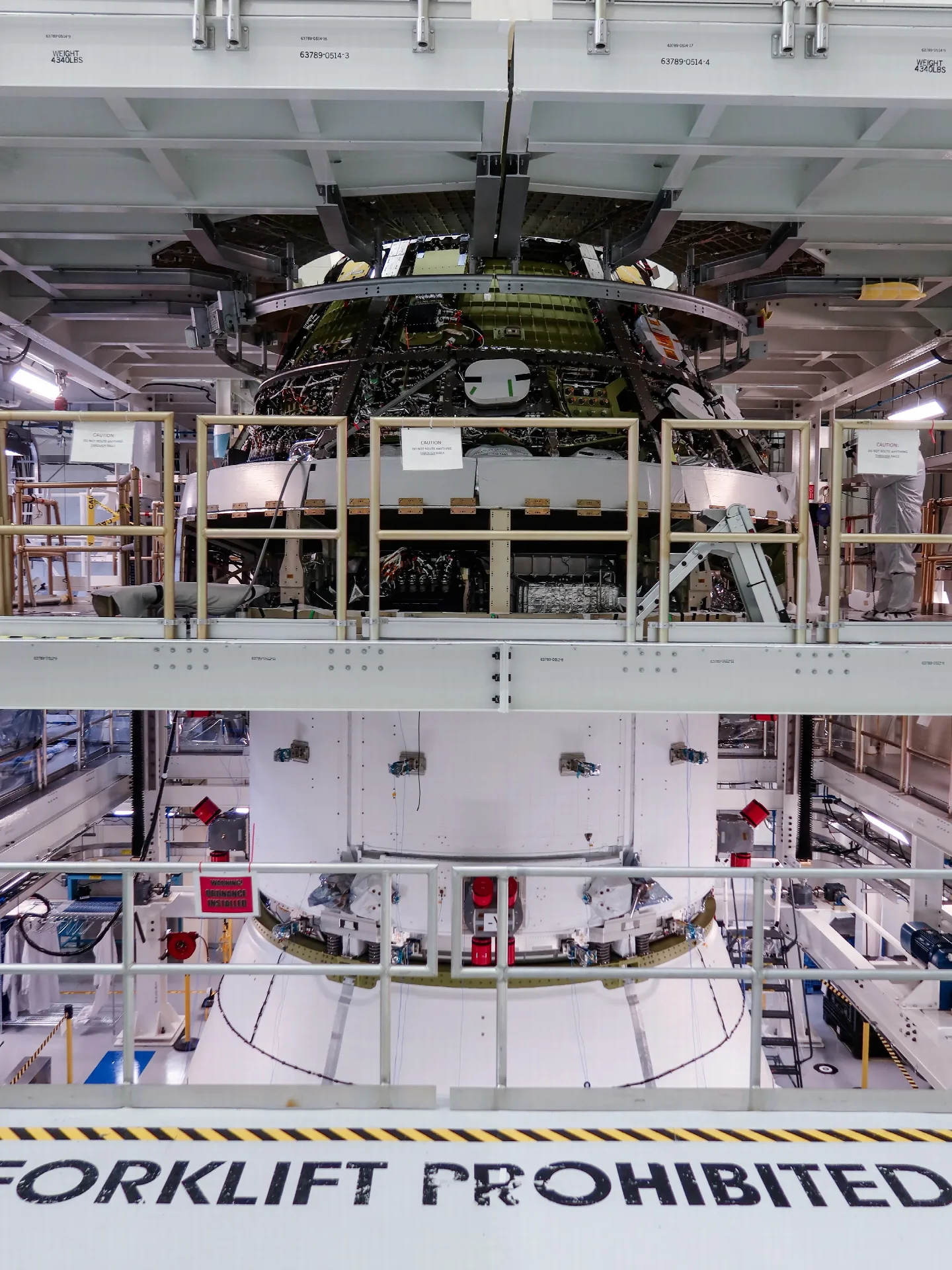
NASA has joined the two principal modules of the Orion spacecraft assigned to Artemis III, giving the agency a complete vehicle for the next phase of integrated testing. The milestone is part of a broader effort to prepare both Orion and the Space Launch System for a crewed demonstration in low Earth orbit next year.
NASA Blogs reported the update on Wednesday, August 5. The agency says work is progressing faster than comparable integration for Artemis II, although the schedule still depends on successful spacecraft power-up tests, completion of rocket assembly and the resolution of any issues uncovered during combined checkouts.
The crew module and European-built service module were mechanically joined on July 30 inside the Neil Armstrong Operations and Checkout Building at Kennedy Space Center in Florida. Engineers had already completed a series of hardware installations and stand-alone tests, an approach designed to identify faults while each component remains accessible before the fully integrated spacecraft becomes more difficult to service.
Orion will carry NASA astronauts Randy Bresnik, Andre Douglas and Frank Rubio, along with European Space Agency astronaut Luca Parmitano. The crew module provides the pressurized cabin, flight controls and Earth-entry capability. The service module supplies propulsion, electrical power, thermal control and consumables needed to sustain the spacecraft and its occupants.
Technicians are now preparing to power on the combined vehicle for the first time. That test will examine electrical paths, data links and command responses across the newly connected modules. Further integrated testing and final hardware installation will follow, with engineers looking not only for individual equipment failures but also for unexpected interactions among systems.
The mission described by NASA is a low-Earth-orbit demonstration rather than a crewed lunar landing. Its central operational objective is to test rendezvous and docking with non-flight test articles representing the commercial human landing systems being developed by Blue Origin and SpaceX. Conducting those exercises near Earth offers a controlled setting for validating navigation, communications, interfaces and crew procedures before similar operations are attempted farther away.
Work on the SLS launch vehicle is proceeding in parallel at Kennedy. Exploration Ground Systems personnel completed inspections and checkouts of the solid rocket booster motor segments in the Rotation, Processing, and Surge Facility. Stacking began in the Vehicle Assembly Building in early July with the left aft assembly, initiating the methodical construction of the rocket’s two large boosters.
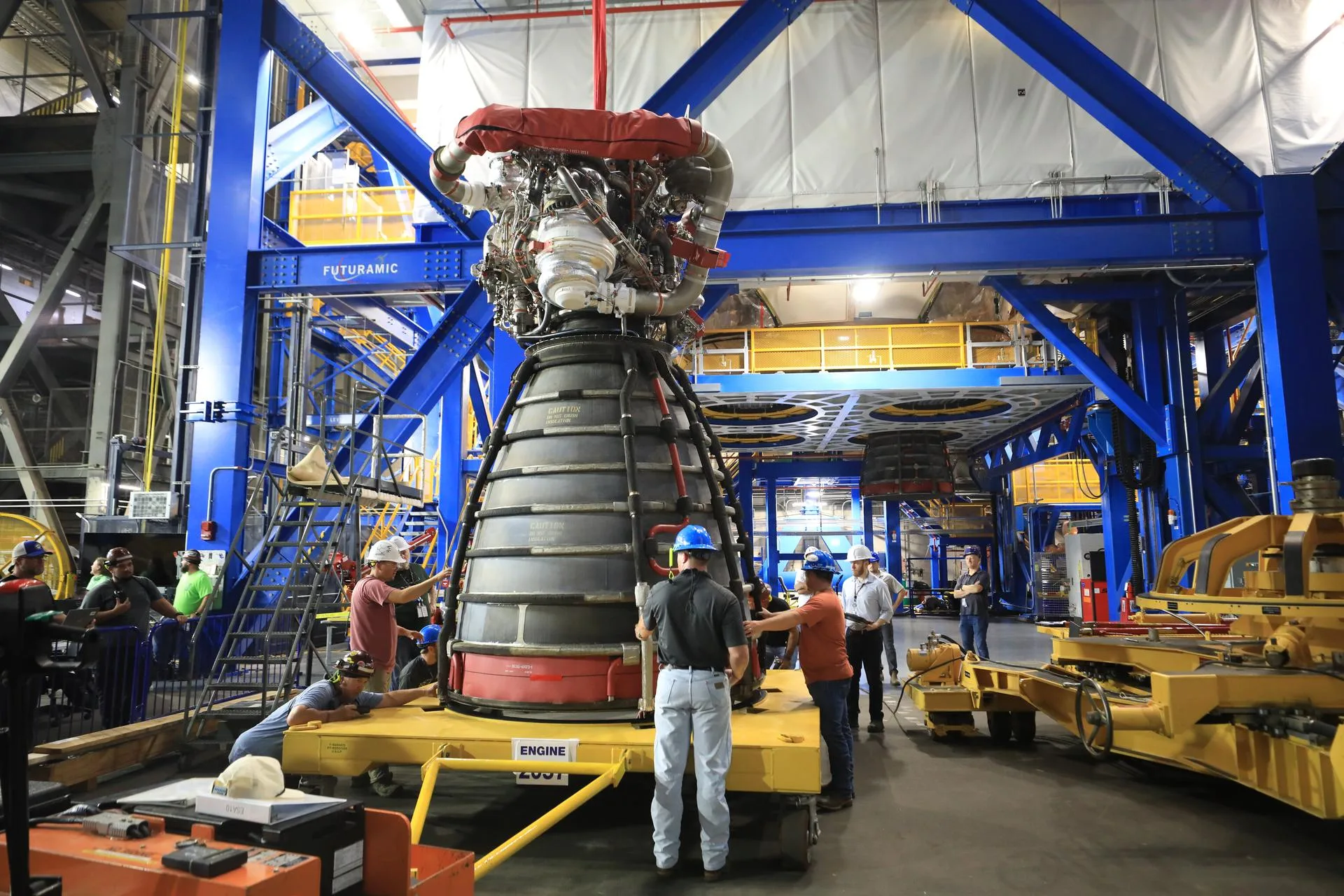
The last RS-25 engine required for the core stage arrived at Kennedy on July 21 from Stennis Space Center near Bay St. Louis, Mississippi. Technicians plan to integrate it during the summer. Four RS-25 engines power the liquid-fueled core stage, operating alongside the twin solid boosters during the demanding opening phase of ascent.
Artemis III will use a non-propulsive spacer where an interim cryogenic propulsion stage would ordinarily be located. The spacer preserves the dimensions and mechanical interfaces of the upper-stage position, allowing the rest of the launch vehicle to retain its established configuration. NASA has reassigned the remaining interim cryogenic propulsion stage to Artemis IV, when its propulsion capability will be needed for the more ambitious mission architecture.
At Marshall Space Flight Center in Huntsville, Alabama, technicians completed the eighth and final friction-stir weld on the spacer barrel. The process joins metal through heat and mechanical mixing without melting it in the conventional manner, producing strong seams suitable for major aerospace structures. The barrel has been removed from its vertical welding tool for inspection, after which upper and lower structural rings are due to be installed.
NASA is also converting structural test articles for the Orion stage adapter and launch vehicle stage adapter into Artemis III flight hardware. Both units were tested at Marshall before Artemis I. Detailed inspections and upgrades are intended to demonstrate that hardware originally used on the ground can meet the stricter condition, documentation and safety requirements imposed on flight structures.
The reuse strategy extends to parts of the Artemis II Orion crew module. NASA estimates that transferring those components will permit installation roughly three months earlier, while freeing hardware originally allocated to Artemis III for Artemis IV more than six months ahead of schedule. More than 250 Artemis II Orion components are expected to support Artemis IV and Artemis V, placing greater emphasis on post-flight assessment and recertification.
Process changes on the ground may prove as important as the hardware decisions. More efficient booster handling accelerated readiness by almost four months. Reinforced mobile-launcher equipment and immediate washdowns after Artemis II reduced the threat of corrosion, contributing to an almost 50% cut in the time needed to return the launch tower to the Vehicle Assembly Building.
Taken together, the measures show NASA adapting Artemis around available hardware, commercial lander development and the need for a more sustainable launch rhythm. Artemis III is intended to retire key integration and docking risks, while SLS, Orion and partner systems are readied for later lunar operations. Under the schedule presented by the agency, demonstrations of the capabilities needed for renewed crewed lunar landings would continue with Artemis IV in 2028.
Read Also
Crew-13 Heads to Florida as Final Launch Preparations Begin
Falcon 9 Clears Stage-Separation Milestone as Booster Turns Home
Artemis III enters a tightly linked phase of hardware and crew preparation