Webb Turns a Masked Mirror Into a Precision Cosmic Interferometer
A specialized observing mode is extracting information below the scale of conventional Webb images. Results from a dusty binary, two forming planets and Jupiter’s moon Io show both the reach and the complexity of the technique.
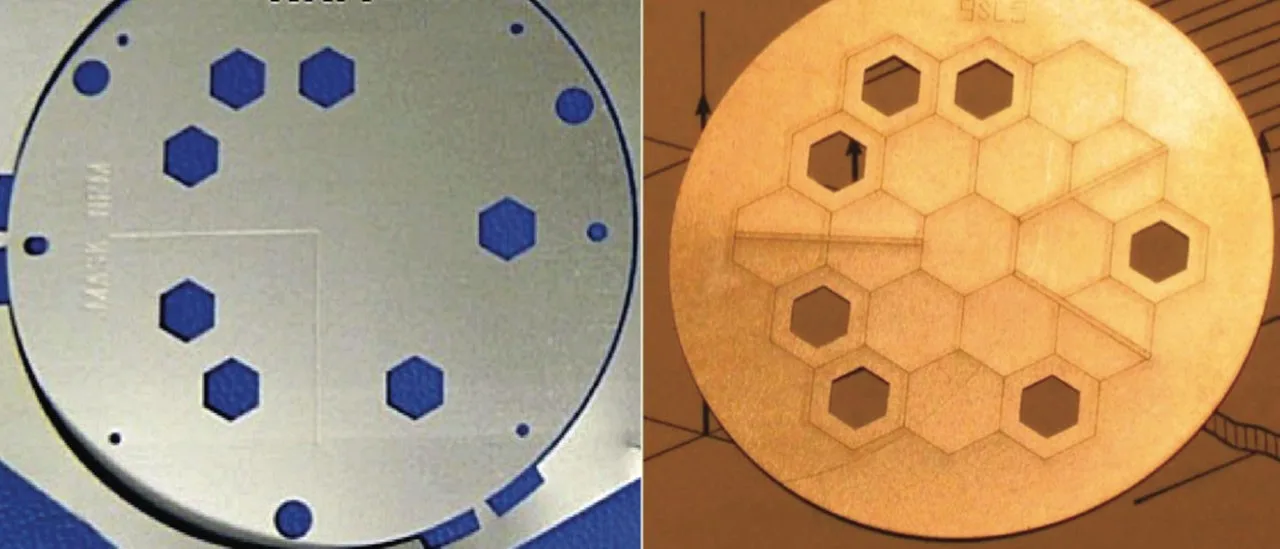
The James Webb Space Telescope was designed around an 18-segment primary mirror whose collecting area and stability have already surpassed key pre-launch image-quality expectations. Yet some of Webb’s most revealing measurements come from deliberately covering most of that mirror and allowing light through only a carefully selected pattern of openings.
NASA Blogs reported the results on Tuesday, August 4. The agency highlighted three applications of aperture masking interferometry, or AMI, spanning a dust-producing massive binary, an infant planetary system and the volcanically active surface of Io.
AMI places a mask with several holes in the optical path, turning selected regions of the primary mirror into a compact array of subapertures. Light from each opening interferes with light from the others, creating fringes that encode the separation, brightness and geometry of structures on the sky. Rather than reading the detector frame as a normal photograph, astronomers reconstruct the source from those patterns.
The method can probe angular scales roughly twice as fine as ordinary Webb imaging under favorable conditions. It is not a universal replacement for direct pictures: blocking the mirror reduces the amount of light, while calibration errors can introduce false structures. Its strength lies in examining bright targets with faint nearby features, particularly when the glare of a star would otherwise overwhelm dust, planets or surface details.
Webb performs these observations with the Near Infrared Imager and Slitless Spectrograph, an instrument built by the Canadian Space Agency. NIRISS combines the stability of a space observatory with a mask whose geometry is designed to keep the interferometric baselines distinguishable. Sophisticated software then converts measurements of fringe amplitudes and phases into physical constraints or reconstructed images.
At Wolf-Rayet 137, the DustERS team used AMI to inspect material created where the winds of two massive stars collide. One member is a luminous Wolf-Rayet star with about 10 times the Sun’s mass, while its companion is approximately 17 times as massive as the Sun. The pair completes an orbit every 13.1 years, repeatedly changing the geometry of the compressed gas between them.
The observations resolved faint dust within the innermost 100 to 200 astronomical units of the collision region. That is several times the Sun-Neptune distance, but at the distance of WR 137 it occupies a tiny angle and lies beside two brilliant stars. In the compressed interface, gas can cool enough for small solid grains to condense despite the otherwise harsh radiation environment.
Researchers had anticipated a pinwheel, the spiral shape commonly produced when an orbiting binary continuously injects dust into space. Instead, the material appeared in a nearly straight linear arrangement. The discrepancy points to additional physics, potentially involving asymmetric winds, orbital orientation, episodic dust production or differences in how efficiently the shocked material cools.
Models were essential for translating the sparse interferometric information into an image of the system. The work also served as a development case for tools that can be reused on other AMI targets. Beyond its unusual appearance, WR 137 matters because dust-forming massive stars help seed interstellar space with processed elements and grains that later participate in the birth of stars and planetary systems.
A different team targeted PDS 70, a roughly five-million-year-old Sun-like star about 370 light-years away. Its surrounding protoplanetary disk contains mostly gas and a small fraction of dust left from star formation. Two directly imaged giant planets, PDS 70 b and PDS 70 c, occupy wide orbits and are still accreting material, offering a view of planetary growth rather than a finished planetary system.
AMI measurements at 4.8 microns precisely established the mid-infrared brightness of both worlds. Each was brighter than atmosphere-only models predicted. The excess is compatible with surrounding material at about minus 50 degrees Celsius, suggesting that warm circumplanetary structures contribute substantially alongside the planets themselves.
That distinction is important because a young planet and its accretion environment can blend into one point of light. Radiation from the hot inner edge of a circumplanetary disk may rival the planet’s own output at these wavelengths. Additional measurements across nearby infrared bands should constrain the dust temperature and location, helping researchers estimate how matter is delivered to the growing planets and perhaps to future moon-forming disks.
Io posed a third and very different reconstruction problem. Its apparent size and complicated surface brightness prevented the straightforward use of standard interferometric imaging algorithms. Researchers instead trained neural-network methods to recover spatial information from NIRISS data, an approach designed to learn relationships too complex for simpler assumptions about the target.
Five images acquired over about 30 minutes identified multiple volcanic hot spots and broader emission across the moon. Structures around 225 miles, or 362 kilometers, were consistent with emission regions associated with individual volcanoes. Features at scales near 360 miles, or 580 kilometers, may trace sulfur dioxide frost previously detected by other observations. Agreement with Keck II telescope data provided an important external check on the neural-network reconstruction.
Together, the cases demonstrate that higher resolution is not achieved by hardware alone. Masks, calibration strategies, physical models and machine learning can extend what a fixed-diameter space telescope is able to measure. That lesson is relevant to future missions, including the proposed Habitable Worlds Observatory, whose ambitions to image planets around other stars will demand exceptionally precise control of light and every practical gain in angular resolution.
Read Also
Parker Probe Survives 29th Solar Dive and Turns Its Camera North
Perseids 2026: NASA prepares for a moonless meteor night
October Skies Bring a Vanishing Jupiter, Meteors and a Hunter’s Moon