Parker Probe Survives 29th Solar Dive and Turns Its Camera North
NASA’s fastest spacecraft has checked in after another record-matching passage through the Sun’s outer atmosphere. The encounter combined direct sampling of the corona with a new look toward the solar north pole.
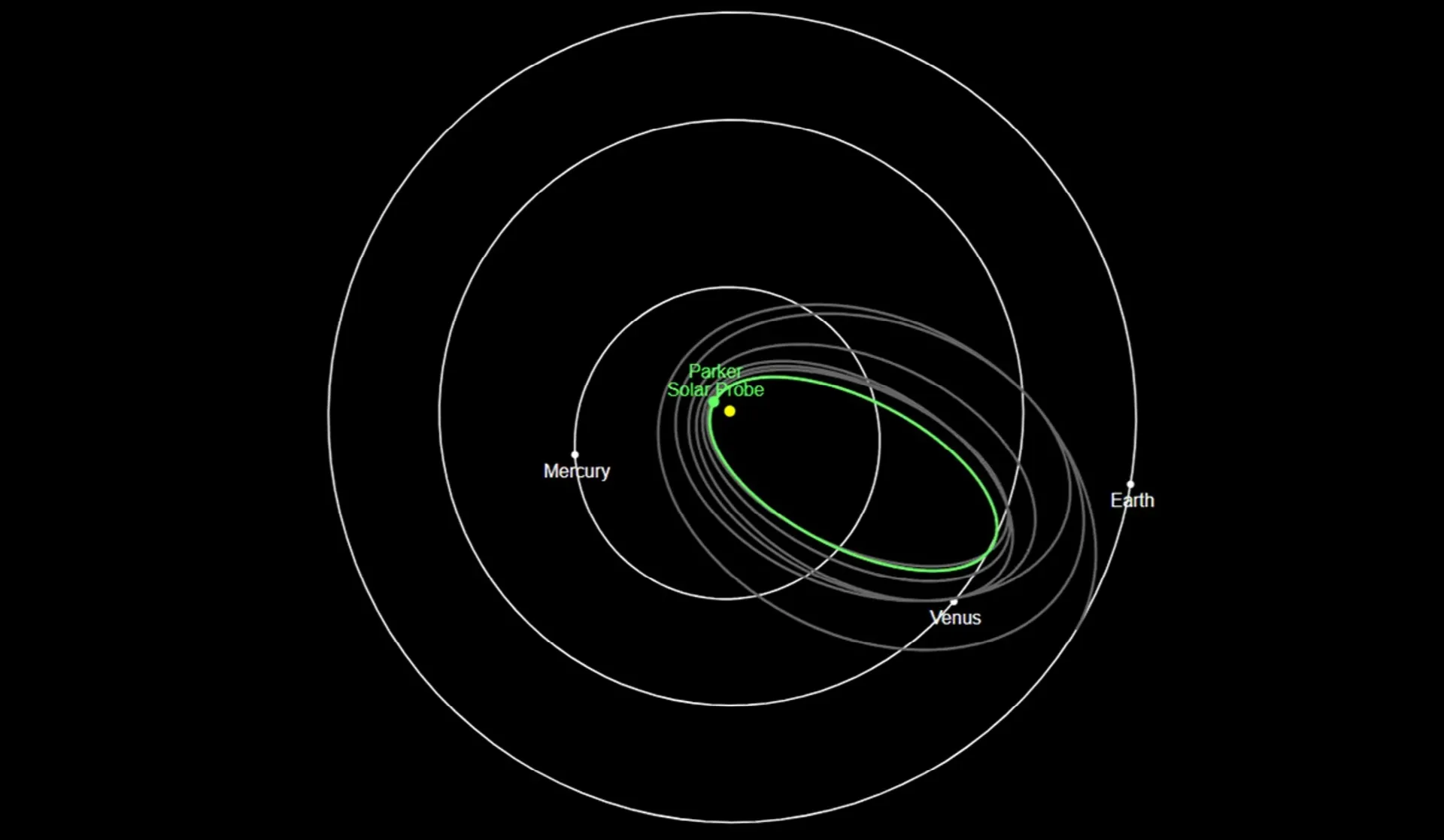
NASA’s Parker Solar Probe has reported normal health after completing its 29th close approach to the Sun, a passage that again took the spacecraft to within 3.8 million miles of the solar surface. NASA Blogs reported the successful check-in on Thursday, September 10, 2026.
Closest approach occurred on September 4, when Parker matched its own benchmarks of roughly 430,000 miles per hour and a minimum distance of 3.8 million miles, or about 6.1 million kilometers, from the surface. Those figures keep it in a class of its own: no other human-made object has traveled faster or operated so deeply inside the Sun’s corona.
The spacecraft was deliberately out of regular contact for nine days around perihelion because its flight path constrained communications with Earth. During that interval, onboard systems followed stored commands and responded autonomously to conditions. A beacon tone received on September 7 provided the first concise confirmation that the probe remained in normal operating condition.
A beacon is not the same as a complete engineering report. It communicates a basic spacecraft status using limited data, while full telemetry allows controllers to examine temperatures, power levels, instrument performance and other details. Parker was scheduled to begin sending that richer engineering record on September 11, followed by science-data transmission from September 13 through September 27.
The extraordinary speed of the flyby allowed Parker to sample a swath equivalent to nearly 40% of the Sun’s circumference in a single day. The comparison describes the arc covered during the encounter rather than a one-day circular orbit, but it illustrates how quickly conditions can change along the probe’s path and how much of the near-Sun environment its instruments can survey in a short window.
All four science instrument suites operated during the broader encounter, which ran from August 30 to September 9. They measured the plasma, energetic particles and electromagnetic fields of the corona, the extended atmosphere that becomes the solar wind. Such measurements place a spacecraft inside the environment that remote observatories can only examine from afar.
This passage added a distinct imaging objective: Parker’s camera was directed toward structures and activity near the Sun’s north pole. Polar regions are central to the star’s global magnetic organization, yet they are difficult to view from Earth because Earth and most solar missions remain near the plane of the solar equator. The images could provide context for the probe’s in-situ readings and reveal how high-latitude features connect to the wider corona.
Scientists are using the mission to investigate a long-standing puzzle: why the corona reaches temperatures far above those at the visible surface and how the solar wind is accelerated to escape the Sun. Parker also encounters the early stages of coronal mass ejections, flare-related disturbances and shock waves before those structures are extensively reshaped during their journey through interplanetary space.
That research has immediate relevance to space-weather forecasting. Solar eruptions can expose astronauts to heightened radiation, disrupt spacecraft electronics, degrade radio links and navigation signals, and alter conditions along polar air routes. Severe geomagnetic storms may also induce currents in long conductors on Earth, including power-transmission infrastructure.
Parker’s scientific value has grown because it has observed the Sun across sharply different levels of activity. The probe launched in August 2018 near the quiet end of the roughly 11-year solar cycle. By 2024, NASA, the National Oceanic and Atmospheric Administration and the international Solar Cycle Prediction Panel had announced that the Sun was in its solar-maximum period.
The mission’s 29 encounters therefore form a developing record of the same star moving from relative calm into an active phase filled with more frequent eruptions and increasingly complex magnetic structures. Parker is expected to remain in its present orbit as activity declines, giving researchers a chance to compare rising, peak and waning conditions with a consistent set of instruments.
A 2026 Heliophysics Senior Review extended the mission through 2029, signaling that NASA considers the spacecraft’s continued returns worth the operational cost and risk. Parker is part of the agency’s Living With a Star program, managed by Goddard Space Flight Center, while the Johns Hopkins Applied Physics Laboratory designed, built and operates the probe. The immediate health signal closes the riskiest chapter of this encounter; the detailed scientific story will emerge only after the full data set reaches Earth.