October Skies Bring a Vanishing Jupiter, Meteors and a Hunter’s Moon
A lunar occultation, two meteor-shower peaks and a bright late-month full Moon will give October skywatchers several reasons to look up. Most require no telescope, but timing and dark skies will make a substantial difference.
October’s astronomy calendar combines a precise planetary alignment with less predictable meteor displays and a full Moon rooted in seasonal tradition. The sequence begins before dawn with Jupiter slipping behind the Moon, continues with the Draconid and Orionid showers, and closes with the luminous Hunter’s Moon.
NASA Blogs reported the observing highlights on Monday, October 5, 2026. The events arrive as nights lengthen across much of the Northern Hemisphere, giving casual observers more opportunities to watch without staying outside until the deepest hours of winter.
The first event is a lunar occultation of Jupiter early on October 6. An occultation occurs when a nearer object crosses in front of a more distant one and blocks it from view. Although Jupiter is vastly larger than Earth’s Moon, distance makes the lunar disk appear wide enough to conceal the planet for roughly an hour.
Observers will first see Jupiter as an unusually bright, steady point close to the Moon’s narrow crescent. It will then disappear at one lunar edge and later emerge from the other. Much of North America lies within the viewing region, with the event beginning around 4 a.m. EDT, though local disappearance and reappearance times will vary.
That geographic variation is central to occultation watching. A person hundreds of miles away may see a different track or timing because the Moon’s apparent position against the distant sky changes with the observer’s location. Local astronomy tables or planetarium software can therefore provide a more useful schedule than a single continent-wide time.
No optical aid is essential because Jupiter is bright enough to see unaided, provided clouds and buildings do not intervene. Binoculars should sharpen the view and may reveal one or more of the planet’s large moons before they are hidden. A steady mount or tripod can help, but viewers should never sacrifice a clear, safe observing location merely to gain magnification.
The Draconid meteor shower follows on the evening of October 8 and into early October 9. Its timing is unusually friendly to families and casual viewers because activity can be watched after nightfall, beginning around 9 p.m. EDT, rather than only in the hours before sunrise. A nearly new Moon should keep the sky relatively dark.
Draconids appear to radiate from the constellation Draco, which supplies the shower’s dragon-themed name. The radiant is an effect of perspective, similar to parallel tracks seeming to converge in the distance. Meteors can flash anywhere overhead, so observers should use their unaided eyes and watch a broad expanse instead of staring through a telescope at Draco.
This is normally a restrained display, with only a few meteors per hour under favorable conditions. Such rates are estimates rather than guarantees: natural fluctuations, clouds, haze and artificial light can reduce the count. Twenty or thirty minutes are also needed for eyes to adapt to darkness, and a bright phone screen can quickly undo that adjustment.
The Orionids peak on October 21, carrying material with a famous origin. Their particles were shed by Halley’s Comet on earlier passages through the inner solar system. When Earth intersects the dusty trail, small grains enter the upper atmosphere at high speed and produce brief streaks as they heat and excite the surrounding gas.
Suburban observers may catch about three to six Orionids an hour, while darker sites could yield somewhat more. A waxing gibbous Moon will initially wash out weaker meteors, making the first part of the night less productive. Conditions should improve after the Moon sets at about 3 a.m. local time and the radiant near Orion climbs higher before dawn.
Orion offers several useful landmarks, including its three-star belt and the red supergiant Betelgeuse. Finding the constellation can confirm that the shower is active, but the best meteor trails may occur well away from the radiant. A reclining chair, warm layers and an unobstructed view are generally more valuable for this activity than a telescope with a narrow field.
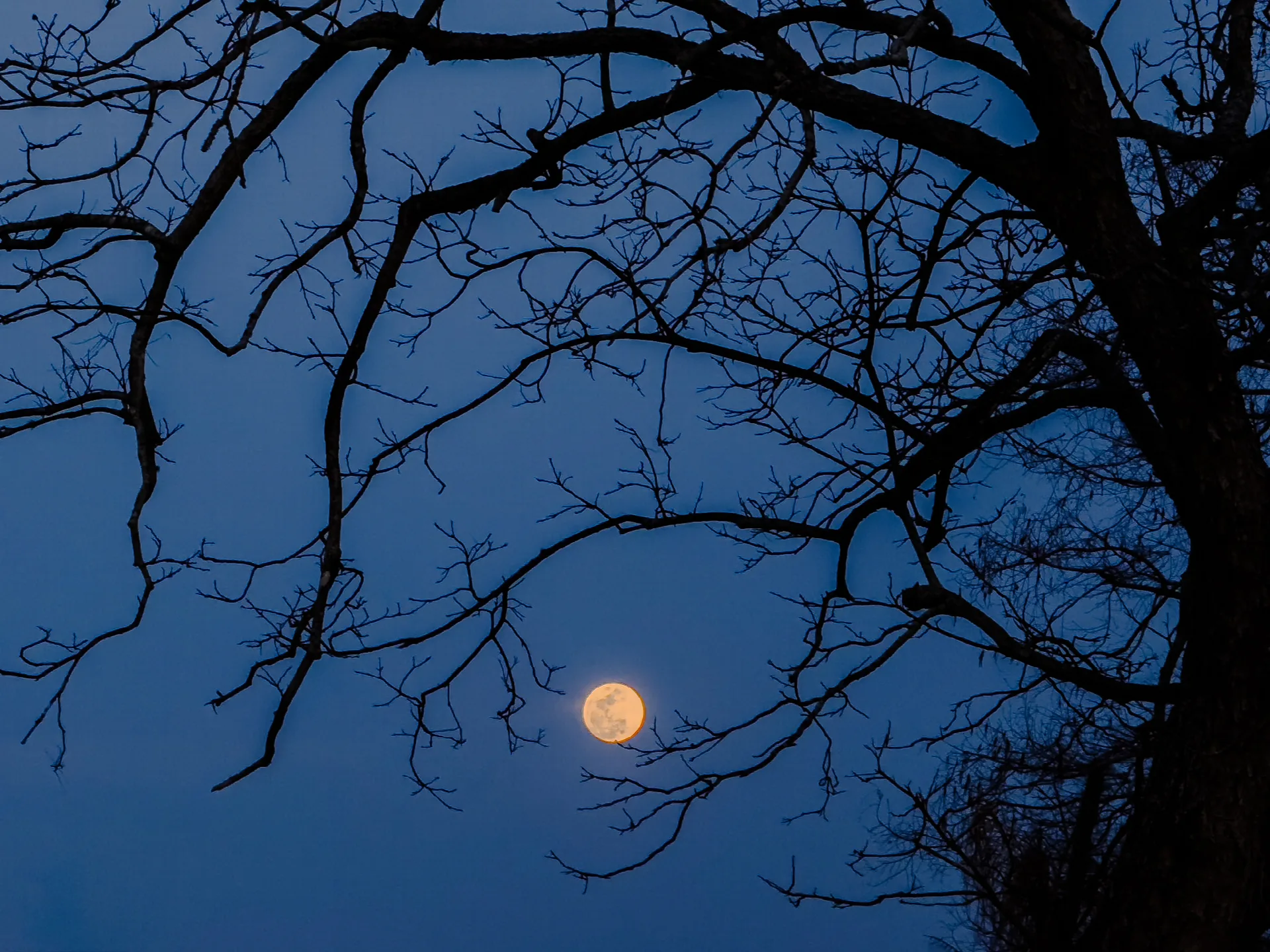
The month’s full Moon arrives on October 26 and is often called the Hunter’s Moon. The expression reflects traditions in which autumn moonlight aided hunting after fields had been cleared and daylight had shortened. It is a cultural and seasonal label, not a sign that the Moon will have a fundamentally different color, size or physical character.
By Halloween, the Moon will be waning gibbous but still capable of casting a noticeable glow. That light will enrich the late-October atmosphere while making faint stars and deep-sky targets harder to see. Weather remains the greatest uncertainty throughout the schedule, so flexible plans, current forecasts and a dark location will determine whether October’s promised celestial tricks become visible treats.