
ISS Crew Closes Week With Plant Science, Health Studies and Dragon Packing
Expedition 75 combined plant-disease research, biomedical monitoring and exercise-device testing with preparations for a SpaceX Dragon return. The work reflects the challenge of making future deep-space crews more self-sufficient.
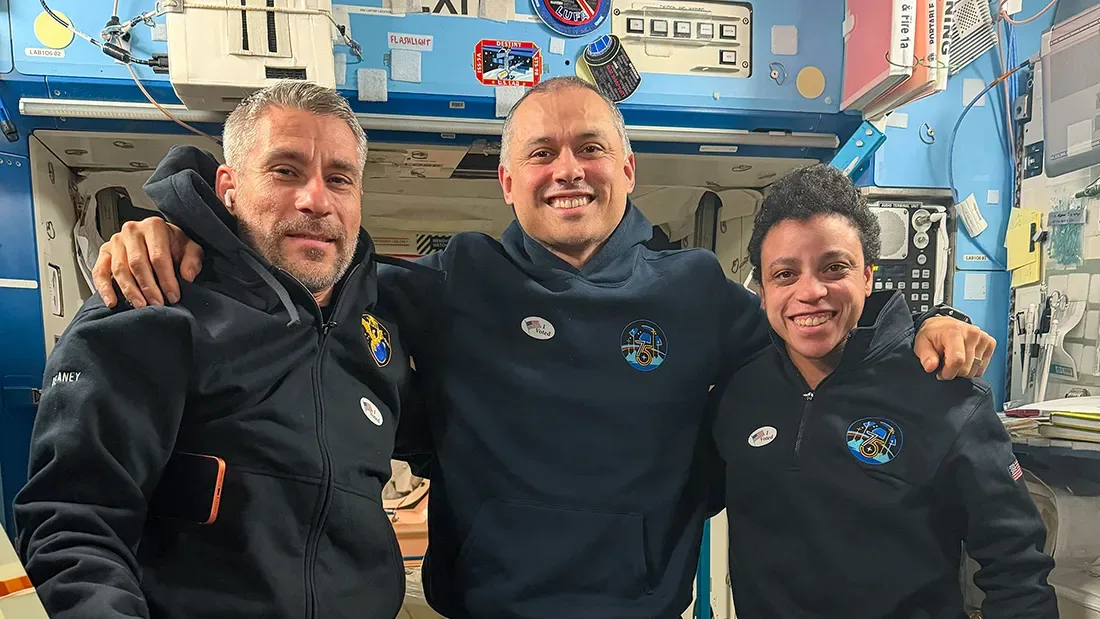
Science operations aboard the International Space Station ended the week with an unusually broad mix of plant biology, human-health monitoring and research-hardware maintenance. At the same time, Expedition 75 crewmembers continued preparing a U.S. cargo vehicle for its departure from the orbital laboratory and eventual return to Earth.
NASA Blogs reported the activities on Friday, November 13. The agency presented the day’s schedule as part of a larger effort to learn how astronauts could secure nutrition and health care when missions take them farther from Earth and reduce opportunities for rapid resupply or medical support.
NASA flight engineer Luke Delaney began by harvesting thale cress from the Multi-use Variable-g Platform inside the Japanese Kibo laboratory module. Thale cress is widely used as a model plant, allowing researchers to examine fundamental biological responses in a relatively small and well-studied organism.
Delaney then worked with the harvested material inside Kibo’s Life Science Glovebox. He treated the samples so they could be preserved and returned to Earth, where investigators would be able to conduct analyses that cannot be completed with the station’s limited laboratory resources.
The experiment focuses on both growth and disease resistance in microgravity. Understanding those mechanisms could matter for spacecraft-based food production on long expeditions, while NASA also sees possible terrestrial applications in agricultural methods intended to produce healthier, more disease-resistant plants.
Elsewhere on the station, Anil Menon serviced the Advanced Space Experiment Processor-4 by replacing sample cassettes and hard drives. The facility had recently supported pharmaceutical and microbiology work, illustrating how orbital equipment can be reused for investigations that exploit conditions difficult or impossible to reproduce under Earth’s gravity.
Jessica Watkins activated student-designed hardware built to observe critical physical, chemical and biological processes in microgravity. NASA said the resulting insights could contribute to new research techniques, improvements in space and Earth technologies, and measures designed to protect astronaut health.
Biomedical work also involved Canadian Space Agency flight engineer Joshua Kutryk. With assistance from Watkins, he collected a blood sample, processed it in a centrifuge and placed it in a science freezer, preserving the material for later examination rather than attempting to complete every stage of the study in orbit.
Kutryk subsequently performed two exercise sessions on the European Enhanced Exploration Exercise Device in the Columbus laboratory module. He used resistance and rowing techniques on E4D, a compact system being evaluated for its potential to help protect muscles and bones during crewed journeys to the Moon, Mars and more distant destinations.
The equipment addresses a practical constraint facing exploration missions: exercise systems must provide meaningful physical loading without occupying excessive volume. The source did not give final performance findings for E4D, indicating that the device remained under investigation rather than describing it as an established solution.
Research logistics converged with cargo operations as Menon and Watkins packed and secured items inside the SpaceX Dragon that reached the station on October 15. Scientific samples were among the materials being readied for return, and NASA and SpaceX support teams were expected to recover the cargo after the capsule’s Pacific Ocean splashdown.
On the Russian segment, Roscosmos cosmonauts Pyotr Dubrov and Anna Kikina studied the use of so-called super-intelligence tools to transcribe crew audio reports for ground controllers. Dubrov also photographed windows in the Zvezda service module, while Kikina measured blood pressure with arm, wrist and finger cuffs. Sergey Teteryatnikov tested a medical-monitoring device through a simulated health check and transmitted the data to physicians on Earth for review.