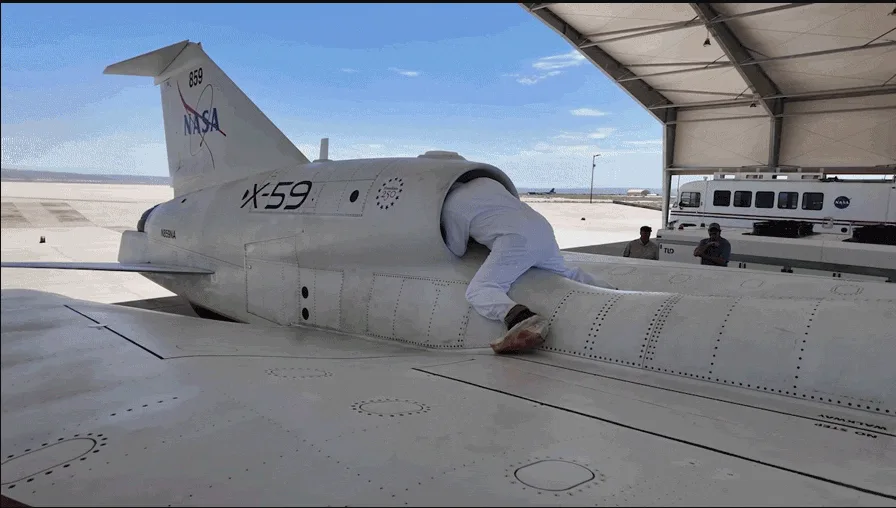
X-59’s First Year Shifts Quesst Toward the Sound Test
NASA’s experimental aircraft has flown 40 times since its October 2025 debut, reaching more than 56,000 feet and Mach 1.53. The program is now preparing to examine whether its distinctive shape produces the quieter sonic signature it was designed to create.
A year after the X-59 first left the ground, NASA’s Quesst mission is moving from cautious systems checks toward the test that defines the program: measuring the sound produced by a purpose-built quiet supersonic aircraft. The jet has completed 40 flights in addition to its October 28, 2025, debut.
NASA Blogs reported the anniversary and the program’s latest figures on Wednesday, October 28. The agency said the aircraft had climbed above 56,000 feet and accelerated as fast as Mach 1.53 during its first year of flight activity.
Those figures contrast with the deliberately limited profile of the inaugural mission. On that first outing, the X-59 remained low and slow while the team checked its systems. Rather than immediately pursuing its headline performance goals, the program began by establishing that the research aircraft behaved as expected in basic flight.
The subsequent campaign has focused on expanding the flight envelope. Each step has exposed the X-59 to a broader combination of altitude, speed and operating conditions, building toward the regimes required across the Quesst mission. NASA said that work would continue in the coming months even as testing begins to take on a new emphasis.
The next major phase is acoustic validation. Future flights are intended to let NASA record and study the sonic thumps generated by the aircraft, turning the mission’s central design premise into something that can be observed and analyzed under flight conditions.
For that purpose, the most relevant numbers are an intended altitude of 55,000 feet and a speed of Mach 1.4. The X-59 is shaped so that flight at those conditions should not deliver the conventional loud sonic boom to listeners on the ground.
Instead, NASA projects that the sound will resemble a thump comparable to a car door closing from roughly 20 feet away. The analogy is significant because Quesst is not simply an attempt to fly faster than sound; it is an effort to alter how the pressure waves associated with that flight are experienced below.
The maximum speed and altitude reached during the first year therefore serve a different purpose from the forthcoming sound measurements. Mach 1.53 and more than 56,000 feet demonstrate how far the envelope-expansion campaign has progressed, but NASA’s account does not present those milestones as proof that acoustic validation is complete.
That distinction also explains why the program is continuing two lines of work at once. Engineers still need to operate through the altitudes, speeds and conditions needed for the wider mission, while the testing effort begins transitioning toward the collection of acoustic data.
After the first flight and 40 additional sorties, the X-59 has accumulated 41 flights in all. The value of that total lies less in the number alone than in the progression it represents: from low-speed checks to operations at and beyond the altitude and speed associated with its intended quiet-supersonic profile.
Quesst’s broader ambition is to help make a new era of commercial supersonic travel over land possible. NASA describes the work as an exploration of a potential market for faster air transportation, with the X-59 serving as the research platform for the mission’s central acoustic question.
The anniversary is consequently a checkpoint rather than an endpoint. NASA has documented substantial performance gains over the aircraft’s first year, but the agency still identifies sound recording and analysis as future work. The coming acoustic-validation phase is expected to test the feature that makes the X-59 relevant beyond a conventional speed demonstration: whether supersonic flight can reach the ground as a comparatively subdued thump.