Voyager 1 Nears a One-Day Communications Frontier
Nearly half a century after launch, Voyager 1 is expected to become the first human-built object separated from Earth by a full light-day. The milestone will turn the enormous scale of interstellar flight into a tangible operational challenge for NASA.
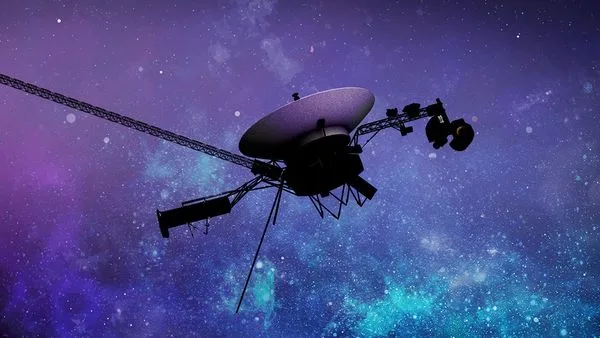
A spacecraft assembled in the 1970s is approaching a distance that can be described more intuitively by time than by kilometers. Around November 2026, Voyager 1 is expected to be roughly one light-day from Earth, meaning a radio transmission traveling at the speed of light would require 24 hours to cross the gap. No other manufactured object has gone nearly as far.
The projected distance is about 25.9 billion kilometers, or roughly 16.1 billion miles. Estimates based on Voyager’s trajectory have placed the crossing near November 15, 2026, although the date may shift as navigation solutions are refined. Earth’s orbital motion also matters: the separation between the planet and the probe expands and contracts slightly depending on which side of the Sun Earth occupies.
That distinction explains why Voyager is expected to become one light-day from the Sun later, around January 2027. A light-day is not a boundary like a planetary orbit, the heliopause or the edge of a magnetic field. It is a unit of distance derived from the approximately 299,792 kilometers that light covers each second, and its importance here is primarily operational and symbolic.
Once the threshold is crossed, a simple exchange with the spacecraft will take at least two days. Controllers will send instructions, wait roughly 24 hours for them to arrive and then wait another 24 hours for Voyager’s response to return. Processing time, antenna schedules and the need for repeated transmissions can stretch a troubleshooting cycle much longer.
This is deep-space engineering with no possibility of direct intervention. Commands must be constructed to account for a power system that weakens every year, aging electronics, very low temperatures and a communications link operating near the limits of detection. Engineers often have to infer the cause of a fault from sparse telemetry before carefully testing a remedy whose result will not be known for days.
Voyager 1 was never designed around such a prolonged assignment. NASA and the Jet Propulsion Laboratory launched it from Cape Canaveral on September 5, 1977, aboard a Titan IIIE-Centaur. Though Voyager 2 had departed first, Voyager 1 followed a shorter, faster path and overtook its twin before the end of that year.
The original mission took advantage of a favorable alignment of the outer planets. During the March 1979 Jupiter encounter, Voyager 1 returned views of turbulent cloud systems, helped identify a faint ring and discovered the small moons Metis and Thebe. Its observations of the Jovian system transformed distant points of light into complex worlds, including the volcanically active moon Io.
At Saturn in November 1980, the probe examined intricate ring structures and photographed a diverse family of icy moons. It identified additional moons and the G ring, while its study of Titan confirmed that the large satellite was concealed by a dense, nitrogen-rich atmosphere containing methane and more complex hydrocarbons. Those findings helped make Titan one of the prime locations for studying prebiotic chemistry beyond Earth.
The Titan encounter came with a major navigational consequence. Passing close to the moon bent Voyager 1’s path northward out of the plane in which most planets orbit, ruling out later visits to Uranus and Neptune. Voyager 2 followed a different trajectory and completed that broader planetary tour, while Voyager 1 began a faster departure toward the frontier of the Sun’s environment.
Before its cameras were retired, Voyager 1 looked back in 1990 to produce a portrait of the planetary neighborhood from billions of kilometers away. Earth occupied less than a pixel in the frame later known as the Pale Blue Dot. The image became one of the mission’s defining cultural artifacts, even though the probe’s longest scientific chapter would rely not on photography but on instruments measuring particles, fields and plasma waves.
Voyager 1 surpassed Pioneer 10 as humanity’s most distant object in 1998. It crossed the termination shock, where the solar wind slows abruptly, in 2004. Measurements later showed that in August 2012 it had passed through the heliopause and entered interstellar space, becoming the first spacecraft to sample the environment beyond the Sun’s wind-dominated bubble.
Interstellar space does not necessarily mean that the probe has escaped the Solar System under every definition. The heliopause marks a plasma and magnetic frontier, not the end of solar gravity. The theoretical Oort Cloud may extend tens of thousands of astronomical units from the Sun, while the region in which the Sun’s gravitational influence competes with neighboring stars lies farther still.
At roughly 17 kilometers per second relative to the Sun, Voyager is extraordinarily fast by familiar standards but slow on an interstellar scale. It will take tens of thousands of years to cover even a few light-years. The probe will pass comparatively near another star in the distant future, but it is not carrying out a targeted voyage to a habitable world and will have been silent for many millennia by then.
Its immediate survival depends on three radioisotope thermoelectric generators. These units derive heat from the decay of plutonium-238 and convert part of it into electricity. Their output has steadily declined, forcing mission managers to ration every watt and to make decisions that would have seemed unnecessary during the encounters with Jupiter and Saturn.
NASA has progressively switched off heaters, backup functions and scientific instruments. The shutdown of another instrument on April 17 formed part of a long-planned sequence intended to preserve power for the most valuable remaining measurements. The strategy accepts a shrinking scientific payload in exchange for a better chance that some observations and engineering data can continue into the next decade.
Maintaining contact is itself a remarkable experiment. Voyager’s faint transmission is collected by NASA’s Deep Space Network, whose large antennas are distributed across California, Spain and Australia to provide coverage as Earth rotates. The signal reaching those receivers is vanishingly weak, requiring sensitive electronics and extensive processing to distinguish meaningful data from background radio noise.
The spacecraft also carries an object that requires no electrical power: the Golden Record. The gold-plated copper disc includes greetings in 55 languages, natural and human-made sounds, music, photographs and diagrams intended to communicate Earth’s location and the method for playing the record. It was conceived less as a realistic attempt to contact extraterrestrials than as a durable statement that the probe’s makers understood they were sending an artifact into deep time.
Voyager’s working life will probably end when declining electricity can no longer support its communications and essential systems, potentially in the early 2030s. The vehicle itself will not stop. With almost nothing in interstellar space to slow it, it will continue along its gravitational path around the Milky Way long after its transmitters fall silent.
Crossing the one-light-day mark will therefore produce no flash, impact or sudden change in the surrounding medium. Its power lies in making distance comprehensible: a message traveling at the fastest speed allowed by physics will need an entire terrestrial day to reach a machine built when Jimmy Carter was president. The milestone is both a triumph of durable engineering and a sobering demonstration of how little of the space between the stars humanity has yet crossed.