
Final Roll-Out Array Spacewalk Targets ISS Power Upgrade
Joshua Kutryk and Anil Menon began a November 5 spacewalk to install the eighth and final IROSA on the International Space Station. The operation was designed to close out a long-running expansion of the orbiting laboratory’s power capacity.
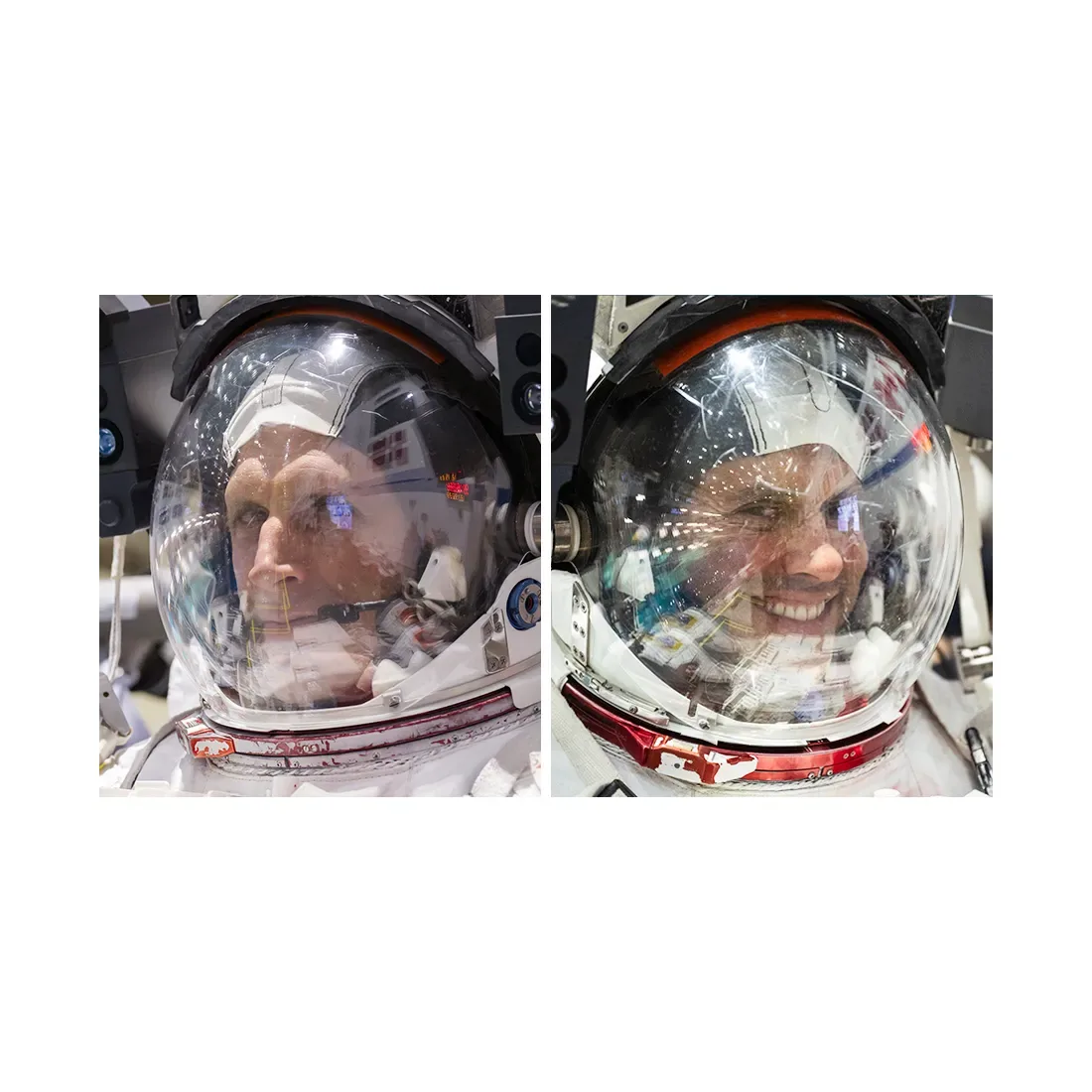
Canadian Space Agency astronaut Joshua Kutryk and NASA astronaut Anil Menon exited the International Space Station’s airlock at 8:36 a.m. EST on November 5, beginning an excursion focused on the station’s electrical infrastructure. Their assignment was to install and deploy the eighth and final ISS Roll-Out Solar Array, or IROSA, on power channel 3B.
NASA Blogs reported the start of the spacewalk on Thursday, November 5. Because the post was issued as the astronauts began their work, it documented the objective and crew configuration rather than providing a final account of whether every task was completed.
Kutryk served as spacewalk crew member 1 and wore the suit marked with red stripes. Menon was designated crew member 2 and wore the unmarked suit. Those visual identifiers are operational aids, allowing flight controllers and camera operators to distinguish the astronauts quickly during a tightly choreographed activity.
The “roll-out” description refers to the way the solar array is packaged and deployed. Instead of relying on a conventional rigid folding structure alone, the photovoltaic blanket can be stored compactly for launch and then extended after it has been attached outside the station. That design makes it possible to add generating area to an already crowded orbital complex.
IROSA units augment the station’s original solar wings rather than requiring the older arrays to be removed wholesale. The legacy wings continue to contribute electricity, while the newer arrays provide additional output as the older photovoltaic cells lose performance after years of exposure to radiation, thermal cycling and the wider space environment.
That gradual degradation is expected in long-duration spacecraft. The ISS repeatedly passes from sunlight into orbital night, subjecting external hardware to large temperature changes. Its equipment must also operate in vacuum while enduring charged particles and other environmental stresses that cannot be eliminated through routine maintenance.
Power channel 3B is part of a segmented electrical network built to generate, route and manage energy across the station. Electricity supports far more than crew accommodations: it keeps life-support components, communications, computers, cooling loops and scientific payloads operating, while also charging batteries used when the outpost is not in direct sunlight.
For that reason, the final IROSA represented more than one additional panel. Its planned deployment was intended to complete the power augmentation upgrades, increasing the electrical margin available for station systems and research. Greater margin can help operators manage competing demands among experiments, maintenance activities and essential services.
The installation itself required work in one of the most unforgiving environments encountered by astronauts. Spacewalkers must remain attached to the station, carry or secure their tools, follow detailed procedures and communicate continuously with controllers on the ground. Pressurized gloves limit dexterity, while the size of external structures demands deliberate movement even in microgravity.
Solar-array work adds particular constraints because a compact launch package ultimately becomes a broad, delicate generating surface. Mounting interfaces, cables and deployment preparations must be handled in the correct order. Ground teams monitor the operation through video, voice communications and station telemetry, ready to guide the crew if the plan needs to be adjusted.
NASA carried the activity through its live digital services, including nasa.gov/live, and promoted updates from the station blog and official ISS social-media accounts. The invitation to watch was tied to the November 5 operation; after the event window, those channels function primarily as records or sources for subsequent status reports rather than as a current live feed.
The source post did not state how the excursion ended or confirm that deployment had been achieved. It therefore supports a precise but limited conclusion: Kutryk and Menon began the spacewalk with the goal of fitting the final IROSA to channel 3B, an operation planned to bring the station’s solar-power augmentation campaign to its final installation stage.