
Final IROSA deployment completes ISS power upgrade
NASA’s Anil Menon and Canadian astronaut Joshua Kutryk installed the eighth roll-out solar array during a six-hour, 59-minute spacewalk. The completed upgrade raises the station’s generating capacity to about 215 kilowatts.
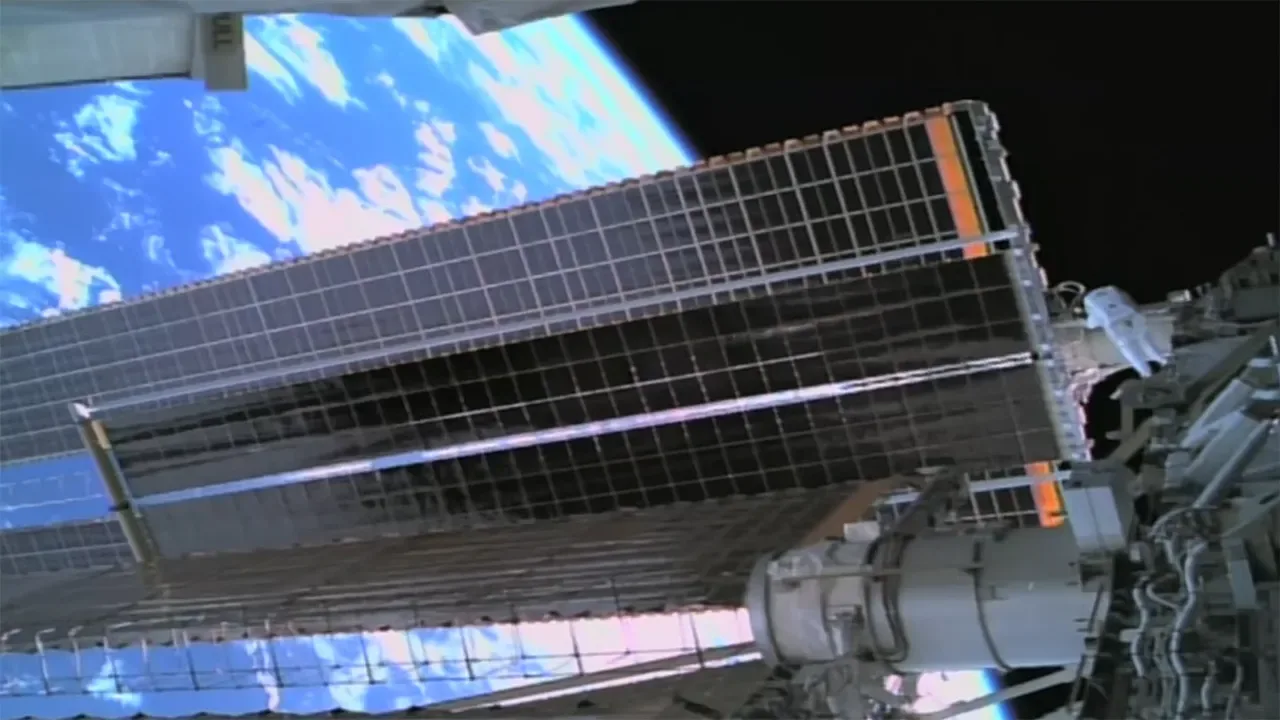
A multi-year effort to reinforce the International Space Station’s electricity-generating system reached its planned endpoint on November 5, when NASA astronaut Anil Menon and Canadian Space Agency astronaut Joshua Kutryk installed and deployed the eighth and final ISS Roll-Out Solar Array.
NASA Blogs reported the completion on Thursday, November 5. The two astronauts ended their excursion at 3:35 p.m. EST after spending six hours and 59 minutes outside the orbital laboratory.
Their principal work site was the station’s 3B power channel. Menon and Kutryk fitted the final International Space Station Roll-Out Solar Array, known by the acronym IROSA, and deployed it as part of the station’s external power system.
The installation closed a campaign that had been under way since February 2021. Rather than consisting solely of eight mounting operations, the project required crews to prepare power-channel equipment before each of the new arrays could become part of the station’s configuration.
Astronauts carried out 18 spacewalks over the course of that campaign. Those excursions covered both preparatory tasks and the installation of all eight roll-out arrays, placing the November 5 operation at the end of an extended sequence of work outside the ISS.
NASA says the combined arrays increase the station’s power-generation capacity from 160 kilowatts to approximately 215 kilowatts. The stated gain is about 55 kilowatts, representing an increase of roughly 34 percent over the earlier figure.
That numerical change is the clearest measure of the upgrade’s scope. The final deployment did not merely add another piece of external hardware; it completed the set on which NASA based the higher generating-capacity estimate.
The excursion was designated U.S. spacewalk 101. It marked Menon’s fifth spacewalk and Kutryk’s second, giving the pair different levels of prior extravehicular experience as they carried out the concluding installation.
Viewed across the full history of the orbital complex, it was the 286th spacewalk devoted to ISS assembly, maintenance and upgrades. The broader total includes the many external interventions needed to build the station, service its systems and alter its hardware over time.
The duration of six hours and 59 minutes underscores that the last array involved a substantial period of activity outside the spacecraft. According to NASA’s account, the crew completed both installation and deployment before the spacewalk ended at the recorded time.
The project’s timeline also illustrates the cumulative nature of orbital infrastructure work. From the start of power augmentation in February 2021 to the final array in November 2026, successive spacewalks prepared equipment and added hardware in stages rather than through a single mission.
NASA characterized the eighth deployment as completing the station’s power-augmentation upgrades. Its account did not announce another roll-out array installation or describe a further phase of this particular campaign, so the confirmed outcome remains specific: all eight IROSA units were installed, and the stated capacity reached approximately 215 kilowatts.