
ISS Crew Readies Final Roll-Out Arrays as Orbital Medicine Takes Center Stage
Expedition 75 entered a demanding phase combining preparations for two late-October and early-November spacewalks with portable diagnostics, cell research and 3D bioprinting aboard the station.
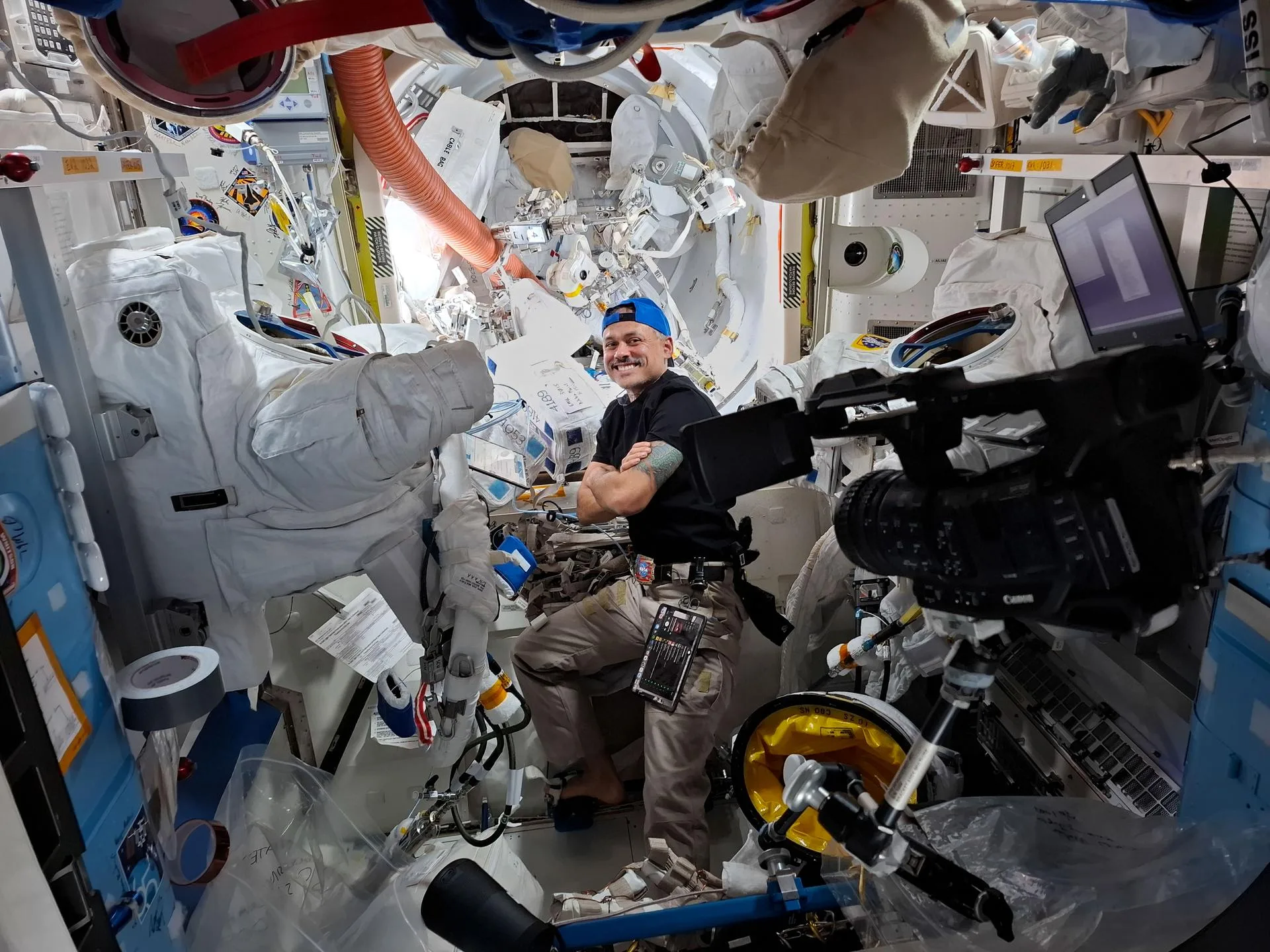
The International Space Station crew began the week of October 19 with two distinct priorities: preparing astronauts and hardware for a pair of spacewalks, and advancing biomedical work intended to make health research more self-sufficient in orbit. The planned excursions on October 29 and November 5 are focused on adding the station’s remaining roll-out solar arrays.
NASA Blogs reported the work on Monday, October 19. Its account described activity across the Quest airlock and the Kibo and Columbus laboratories, as well as a separate schedule of experiments and logistics on the Russian segment.
NASA flight engineer Anil Menon and Canadian Space Agency flight engineer Joshua Kutryk are assigned to the first excursion on October 29. They are due to install a roll-out solar array on the port side of the station’s truss. The operation would mark Menon’s fourth spacewalk and Kutryk’s first, giving the pairing a mix of previous extravehicular experience and a debut outside the orbiting complex.
A second outing is planned for November 5, when the same astronauts are expected to work on the starboard side. That installation is described as the eighth and final roll-out solar array for the station. The two excursions therefore form a connected sequence rather than isolated maintenance events, with each requiring its own equipment configuration, suit servicing and ground coordination.
The roll-out design allows a solar array to travel in a compact form before being deployed in orbit. Installing such equipment on the station’s truss demands carefully choreographed movement outside the pressurized modules, where astronauts must manage restraints, tools and connections while relying on their suits for cooling, oxygen and communications. Extensive preparation inside the station is consequently an essential part of the mission rather than a preliminary formality.
On October 19, Menon worked in the Quest airlock and cleaned cooling loops in two spacesuits. The loops help regulate temperature and keep crew members comfortable during hours of physically demanding activity in vacuum. Kutryk later loaded clean water into suit tanks and into the liquid cooling and ventilation garments worn beneath the outer pressure suits.
The two spacewalkers also joined NASA flight engineers Luke Delaney and Jessica Watkins for a conference with mission controllers. Such reviews allow the crew and ground teams to compare procedures, assignments and equipment status before an excursion. NASA had additionally scheduled a media briefing at Johnson Space Center for October 20, with streaming through platforms including YouTube; the original station update did not state the outcome of that briefing.
Away from the airlock, Delaney worked with an experiment recently carried to orbit by a SpaceX Dragon spacecraft. The investigation is designed to demonstrate analysis of crew biological samples aboard the station, rather than sending every sample back to Earth. The central question is whether portable and compact tools can provide useful health information faster while reducing dependence on return opportunities and large terrestrial laboratories.
That capability could become increasingly relevant as missions extend farther from Earth, where regular sample transport would be difficult. NASA said quicker orbital testing might eventually support personalized treatments for astronauts. The study remains a technology and research demonstration, however, and the agency’s description did not present it as an operational medical service already in routine use.
Watkins began her shift in the Japanese Kibo laboratory, servicing delicate sample-processing equipment and placing fluid loops containing samples in a science freezer. Preserving material under controlled conditions is a less visible but indispensable part of orbital research, because later analysis depends on maintaining sample integrity throughout collection, processing and storage.
She then configured the BioFabrication Facility in the European Columbus laboratory for work during the week. The equipment was to print blood-vessel structures from cells donated by patients with a rare genetic condition that causes rapid aging. In microgravity, researchers can observe cellular behavior and three-dimensional tissue formation without the same gravitational effects encountered in an Earth laboratory.
NASA said observations from the work could offer deeper insight into the cellular disorder and possibly contribute to advanced therapies for the accelerated-aging disease. The experiment links a narrowly defined medical question to a broader challenge in biomanufacturing: learning how living cells organize into complex structures when weight no longer dominates their physical environment.
The station’s three Roscosmos cosmonauts pursued a parallel set of assignments. Commander Pyotr Dubrov examined complex plasmas, mixtures of ionized gas, neutral gas and microscopic particles that can become strongly charged and form plasma crystals. Findings from this research may inform future spacecraft design and provide new research techniques, according to the agency’s summary.
Sergey Teteryatnikov studied tools described as super-intelligence systems that could improve crew efficiency and transcribe reports for mission-control review. Anna Kikina organized food packages so they could be consumed before expiration and documented hardware locations in the Zarya module. Together, the day’s activities illustrated how station operations combine experimental science, inventory discipline and preparation for high-risk work outside the spacecraft.