
Dragon Delivery Opens a New Research Cycle Aboard the ISS
A SpaceX cargo spacecraft brought more than 6,300 pounds of research hardware, supplies and roll-out solar arrays to the International Space Station. Expedition 75 began transferring sensitive samples while preparing biological studies and future power-system upgrades.
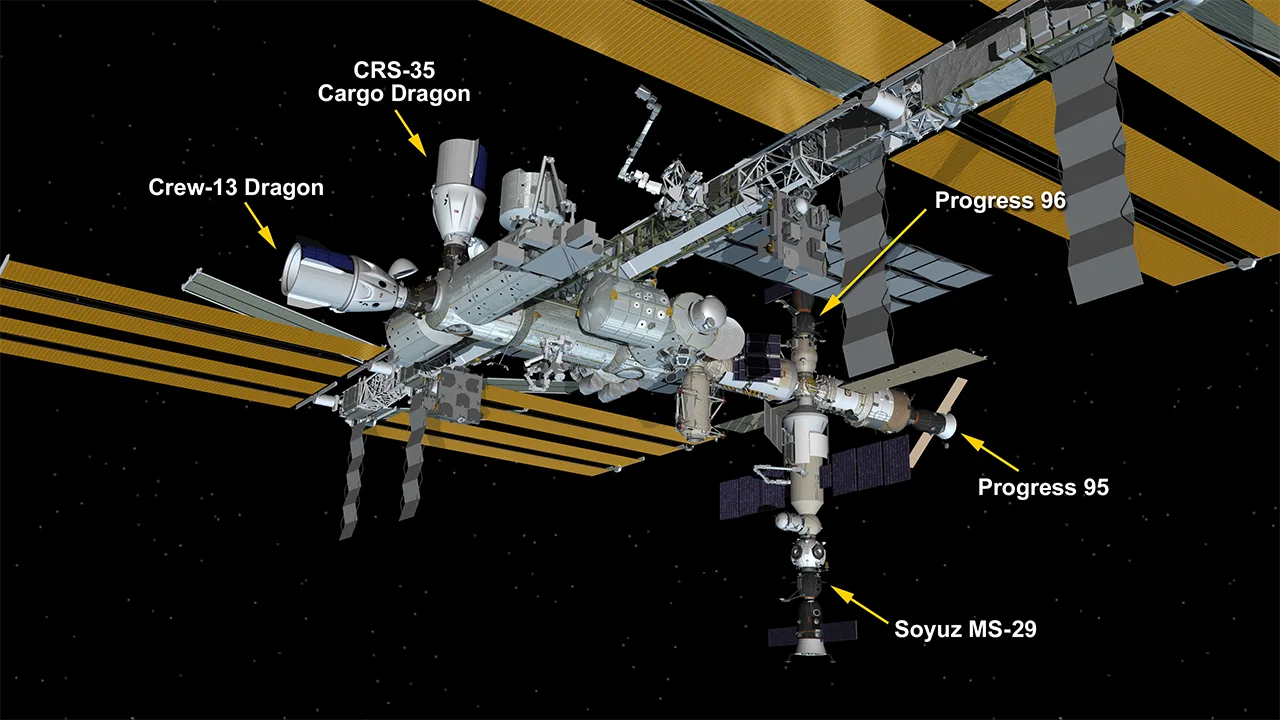
A cargo-laden SpaceX Dragon reached the International Space Station on October 15, adding an uncrewed spacecraft and more than 6,300 pounds of equipment to the orbiting laboratory’s traffic and logistics schedule. At the time described in the original update, five spacecraft were docked to the station.
NASA Blogs reported the unloading operation on Friday, October 16. That account captured the opening phase of the work rather than its eventual outcome, and it provided no later confirmation of how the experiments scheduled for activation through the October 16–18 weekend progressed.
The Dragon completed an automated docking at 10:27 a.m. EDT at Harmony’s space-facing port. It had lifted off from Florida at 6:33 a.m. on October 14 atop a Falcon 9 rocket. The automated rendezvous brought the cargo vehicle to the station, but opening it still required a sequence of checks by the crew.
NASA flight engineer Anil Menon tested pressure and checked for leaks before equalizing the atmosphere between the station and Dragon. He then opened the hatch and entered the spacecraft. NASA colleagues Jessica Watkins and Luke Delaney followed him, together with Canadian Space Agency astronaut Joshua Kutryk.
Their first tasks focused on time-sensitive science cargo. The four crew members transferred samples from portable freezers and incubators into the station’s permanent science freezers and research racks. This was a crucial handoff in the delivery chain because the specimens had to remain in controlled environments while awaiting study and analysis.
Several of the newly delivered investigations centered on biological structures that can be difficult to study under normal terrestrial gravity. One project was intended to explore the creation of artificial retinas, while another involved growing heart tissue in weightlessness. NASA’s account described the research objectives but did not present findings from either experiment.
Protein crystallization formed another part of the science program. Researchers intended to grow crystals in microgravity with the longer-term aim of supporting more precise cancer treatments. The connection to medicine was presented as a research goal, not as evidence that a treatment had already been developed or validated aboard the station.
A plant experiment was designed to observe genetic responses to microgravity. Understanding those responses could help advance spacecraft life-support concepts for long-duration exploration, where reliable biological systems may become increasingly significant. The source did not claim that the investigation had already produced a usable life-support technology.
The cargo mission also carried hardware that will eventually contribute to the station’s electrical supply. Two roll-out solar arrays were packed in Dragon’s unpressurized trunk. Under the stated plan, ground controllers would command the Canadarm2 robotic arm to extract them and temporarily place them on logistics platforms attached to the station’s truss.
Menon and Kutryk were assigned to finish installing the arrays during spacewalks scheduled for October 29 and November 5. Those dates remained in the future as of October 19. Once installed and activated, the arrays were expected to augment the station’s power-generation system, although the October 16 update did not report that the extraction or installation had yet occurred.
Elsewhere aboard the station, commander Pyotr Dubrov and Roscosmos flight engineer Anna Kikina completed a weeklong investigation involving the Teledroid exoskeleton suit. Wearing virtual-reality goggles and using hand controls, they manipulated tools in a simulated space setting to examine how a person might remotely operate robotic systems.
NASA said the study could help crews prepare for remote robotics work on future long-duration exploration missions. Such operations may allow astronauts to interact with machinery beyond their immediate reach, but the update confined itself to the experiment and its potential value; it did not identify a specific mission or announce an operational system.
Roscosmos flight engineer Sergey Teteryatnikov took part in a separate virtual-reality investigation. He wore a headset and responded to computerized stimuli intended to test how balance and spatial orientation adapt to weightlessness. He also inspected hydraulic components and serviced the Elektron oxygen generator before finishing his workweek.
The October delivery therefore linked immediate logistics with research and infrastructure planning. Crew members had to protect sensitive samples, begin configuring a varied portfolio of experiments and prepare major external hardware for robotic handling and spacewalk installation. The source documented those opening activities without supplying subsequent experimental results or confirming the completion of the planned weekend activation work.