
Artemis III SLS Takes Shape as NASA Prepares a Short-Stack Fueling Test
NASA has installed the final solid-booster motor segments and all four RS-25 engines for Artemis III. The next campaign links hardware integration at Kennedy with pad work, Orion testing and extensive crew rehearsals.
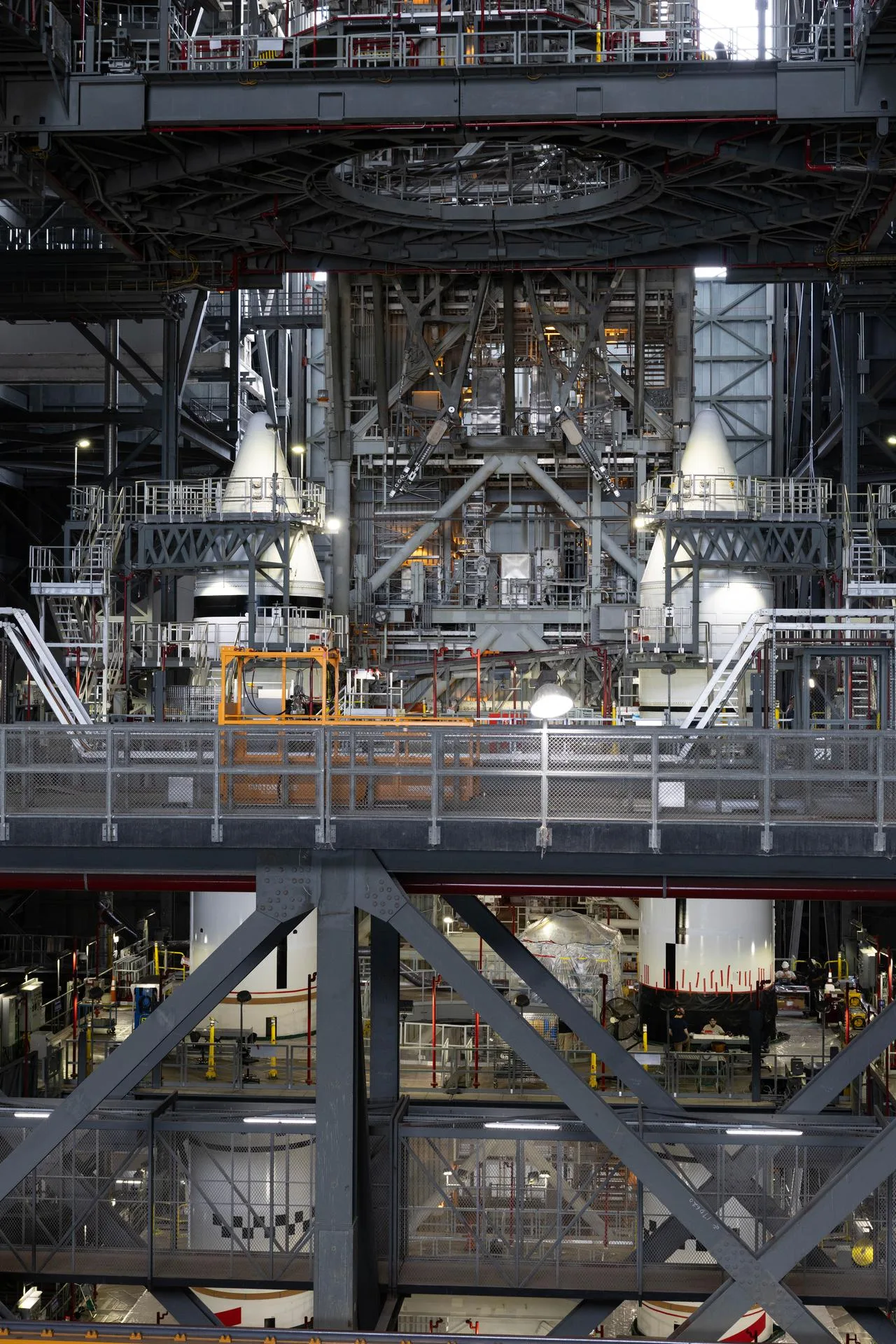
The Space Launch System assigned to Artemis III moved closer to its first major ground exercise after technicians at Kennedy Space Center completed installation of the final solid rocket booster motor segments on the mobile launcher. All four RS-25 engines also had been fitted to the core stage, bringing two of the launch vehicle’s largest propulsion elements to an important integration point.
NASA Blogs reported the status on Tuesday, October 13. Although NASA described booster stacking as complete, the update did not say that the full rocket had been assembled: the core stage still had to be joined to the boosters to produce the limited “short stack” required for a tanking test.
Work on the core stage was due to continue with installation of a systems tunnel running along its length. The tunnel carries pyrotechnic cabling and wiring associated with a single-use quick disconnect, part of the system that enables controlled separation of launch-site connections during liftoff. Such equipment is less visible than engines or tanks but is essential to coordinating the transition from a vehicle supported by the ground to one in flight.
Once the core was ready, teams planned to position it between the two solid boosters inside the Vehicle Assembly Building. That operation was expected to complete the short-stack configuration. NASA gave no exact date for the integration in its October 13 account, describing it as work for the following weeks.
The partially assembled SLS was then expected to travel on its mobile launcher to Launch Pad 39B in the ensuing months. There, the Artemis launch team planned to rehearse the procedures and timing for loading propellants. The source update outlined the prospective test but did not provide results or establish that the rollout had subsequently taken place.
A pad stay would also provide a realistic setting for a launch-day rehearsal by Randy Bresnick, Frank Rubio, Andre Douglas and European Space Agency astronaut Luca Parmitano. The planned sequence extended from putting on their gear in the crew quarters and riding to the pad to climbing the mobile launcher and walking the emergency exit route available during a countdown contingency.
Meanwhile, refurbishment continued on Pad 39B’s flame deflector. NASA said the structure sustained minimal damage during Artemis II and that the bricks lining the flame trench were unaffected. The agency attributed that performance to ground-system improvements introduced after experience with Artemis I in 2022, illustrating how one mission’s launch environment can shape preparations for the next.
The Orion spacecraft represented a separate but interconnected stream of work. Engineers from ESA and Airbus inspected the solar-array wings that power the European service module. The module supplies propulsion, thermal regulation and electrical power while also supporting the crew with air and water, making the arrays part of a wider chain of mission-critical services rather than a stand-alone electrical component.
At Marshall Space Flight Center in Alabama, welding of the forward and aft rings completed the primary structure of an Artemis III spacer. Dimensional checks were under way on the component, which is intended to represent upper-stage dimensions. Its role underscores that the mission-specific launch configuration includes structural solutions beyond the most recognizable SLS stages.
Marshall teams were also turning two former structural test articles into flight-ready hardware: the Orion stage adapter and the launch vehicle stage adapter. Exterior painting of the Orion adapter had been completed, with cables and brackets next in the work sequence. Corrosion removal on the launch vehicle adapter was nearly finished ahead of nondestructive evaluation, protective treatment, painting and application of thermal-protection foam.
NASA expected the spacer and both adapters to be shipped to Kennedy early in 2027. Until that transfer, Artemis III processing remained geographically distributed, with launch-vehicle assembly in Florida, structural conversion in Alabama and spacecraft inspections involving NASA’s European partners. Keeping those schedules aligned was implicit in the broader integration effort, though the source did not announce a final completion date.
Crew preparation was similarly broad. The astronauts practiced assembly and use of a compact flywheel exercise device, evaluated nearly 200 food choices, escaped from a submerged inverted helicopter mock-up and rehearsed water recovery with NASA, military partners and U.S. Navy helicopters. Suited sessions in the Orion Crew Survival System covered communications, deorbit work, emergency equipment and cabin configuration. Together, the hardware and training updates portrayed Artemis III as a coordinated readiness campaign, while leaving the outcome of the future tanking test and remaining assembly work unresolved.