From Military Service to the X-59 Flight Deck
NASA’s three X-59 test pilots bring military backgrounds, engineering knowledge and extensive flying experience to the Quesst mission. Their work extends beyond piloting the experimental aircraft to support flights and technical collaboration.
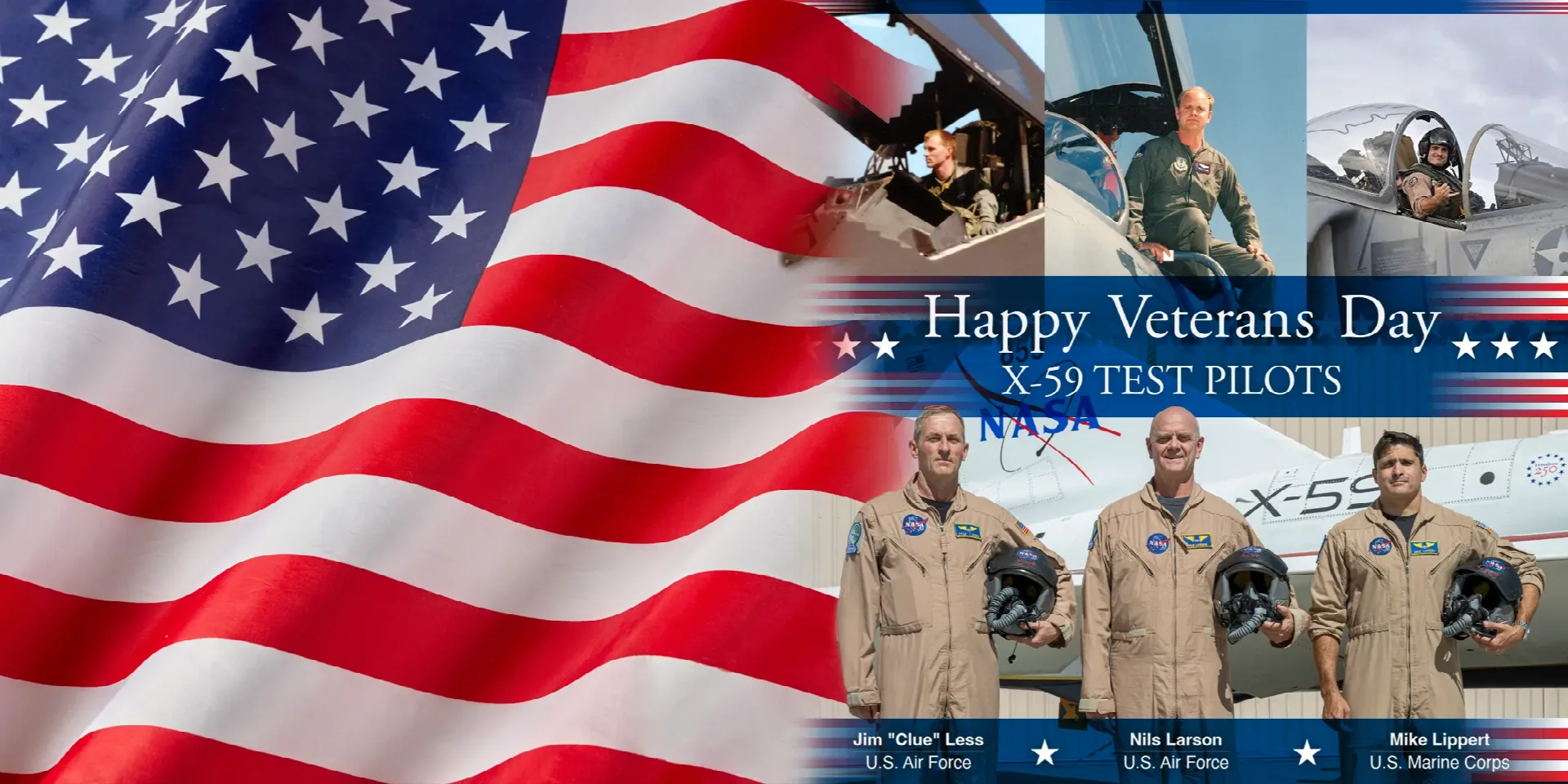
NASA used Veterans Day to highlight the service behind its X-59 experimental aircraft, recognizing three test pilots whose careers connect military aviation with civilian aerospace research. Jim Less, known by the call sign Clue, Nils Larson and Mike Lippert contribute decades of operational, technical and flight experience to the Quesst mission.
NASA Blogs reported the tribute on Wednesday, November 11. The agency also extended its thanks to other U.S. armed forces veterans working across Quesst, emphasizing both their earlier sacrifices and their continuing role in advancing aviation.
Less and Larson served in the U.S. Air Force, while Lippert served in the U.S. Marine Corps. Their paths illustrate how experience acquired in uniform can continue to serve a public purpose after a military career, particularly in a field where disciplined preparation and technical judgment are essential.
The X-59 is the specialized research aircraft at the center of Quesst, NASA’s effort to explore a quieter approach to supersonic flight. Rather than treating speed as the only measure of success, the mission focuses on the sound produced as the aircraft travels faster than sound and on how that sound is experienced from the ground.
That objective gives the pilots a role far broader than simply operating the controls. A research flight must be executed with precision so that engineers can relate the aircraft’s configuration, route and performance to the information collected during the mission.
Test pilots also serve as interpreters between a complex aircraft and the engineering teams studying it. Instruments can record speed, altitude and system behavior, but pilot observations help describe handling qualities, workload and the way separate systems function together during an actual flight.
NASA noted that the three aviators may contribute in several capacities. Depending on mission needs, they can fly the X-59, operate support aircraft, or apply their engineering and technical expertise away from the cockpit.
Support-aircraft assignments are not secondary to the research effort. Experimental aviation relies on coordinated crews and platforms to observe operations, maintain situational awareness and help gather the information needed to understand each test flight.
Military aviation provides a strong foundation for that environment. It develops procedural discipline, familiarity with demanding flight regimes and an ability to communicate clearly when conditions are complex, although the purpose within Quesst is scientific rather than operational or combat-related.
The pilots’ engineering backgrounds are equally relevant. Research programs depend on a continuous exchange among aircrews, designers, analysts and ground personnel, with each flight producing observations that can inform later technical work.
By focusing on Less, Larson and Lippert on Veterans Day, NASA placed the human element alongside the X-59’s distinctive technology. Experimental aircraft attract attention because of their design and performance, but their value depends on teams capable of operating them methodically and explaining what occurred.
The tribute therefore recognized more than past service. It underscored a continuing commitment in which veteran aviators apply experience, judgment and technical knowledge to a civil research mission intended to improve understanding of supersonic flight.
Quesst’s broader importance rests on the quality of the evidence it can produce, not on a single pilot or sortie. Within that process, however, the X-59 flight team occupies a critical position: turning an advanced aircraft into a carefully controlled research tool.
For Less, Larson and Lippert, work on the mission represents continuity as much as transition. Their uniforms and organizations may have changed, but NASA’s message presented their current contribution as another form of service—one directed toward the future of flight.