
ISS Crew Closes Out Week After Major Solar Array Upgrade
Expedition 75 astronauts serviced spacesuits and reviewed a nearly seven-hour spacewalk that completed a years-long increase in the station’s power-generating capacity. Biomedical studies and routine maintenance continued across the orbital complex.
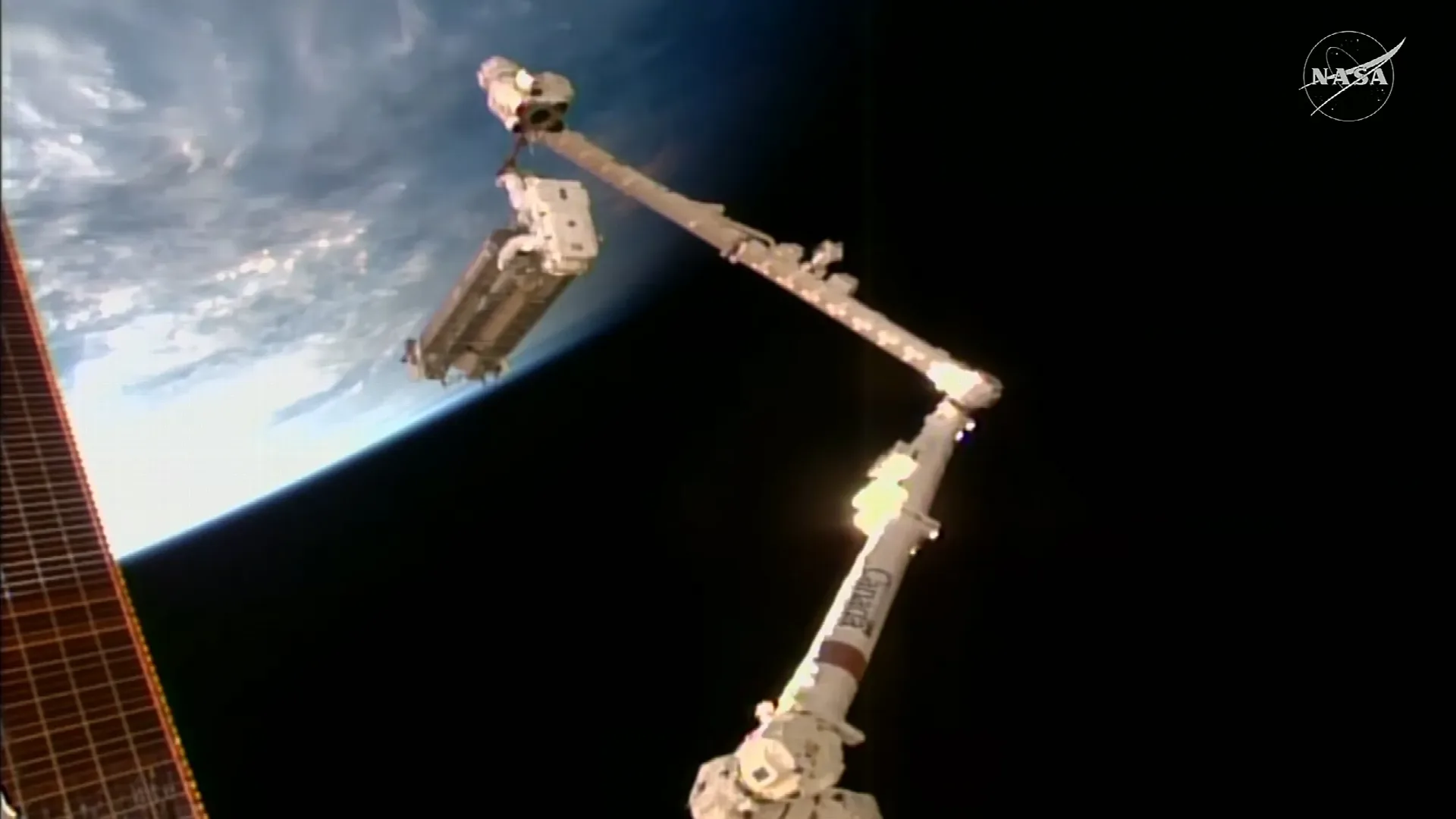
The seven members of Expedition 75 closed out a demanding week aboard the International Space Station by restoring spacewalk equipment, gathering biomedical data and maintaining essential orbital systems. The work followed the installation of the eighth roll-out solar array, the final step in a years-long effort to expand the outpost’s electrical capacity.
NASA Blogs reported the crew’s activities on Friday, November 6. The update covered operations in the Quest airlock and elsewhere in the U.S. segment, as well as medical research, ventilation servicing and structural inspections in the Roscosmos portion of the station.
Canadian Space Agency flight engineer Joshua Kutryk and NASA flight engineer Anil Menon had spent six hours and 59 minutes outside the station on Thursday, November 5. Their principal task was to install the final roll-out array on the station’s truss, completing a sequence of upgrades intended to raise overall power generation.
NASA said the program increased the station’s generating capacity from 160 kilowatts to 215 kilowatts, an improvement of about 30%. Although the last installation provided a clear milestone, the agency described it as the culmination of work conducted over several years rather than an isolated spacewalk accomplishment.
Once back inside, Kutryk and Menon began converting the Quest airlock from spacewalk operations to its normal configuration. On Friday they refilled water tanks in their spacesuits, removed air bubbles from those tanks and fitted rechargeable batteries inside the suits. The servicing was necessary to keep the equipment ready to protect astronauts and regulate their comfort on later excursions.
The two crew members also inspected the suits and tools they had used, placed gear in protective covers and stowed it in the airlock. They cleaned the workspace and verified that equipment supporting the excursion had been powered down. These steps illustrate how an extravehicular activity extends beyond the hours officially recorded outside the station.
NASA astronauts Jessica Watkins and Luke Delaney contributed to both phases of the operation. On Thursday they helped Kutryk and Menon enter and leave their spacesuits, monitored the activity from inside the station and operated the Canadarm2 robotic arm. They returned to the Quest cleanup effort on Friday.
All four astronauts then joined engineers on Earth for a post-spacewalk conference. The discussion gathered the participants’ perspectives for use in preparing astronauts and mission controllers for later work outside the orbital complex. NASA did not disclose specific observations from the review, but emphasized its role in future preparation.
The conference brought together viewpoints from both sides of the airlock. Kutryk and Menon could describe conditions encountered during the nearly seven-hour excursion, while Watkins and Delaney could assess suit support, internal monitoring and robotic-arm operations. That combination provided ground teams with an account encompassing more than the actions performed outside.
After a week filled with science, maintenance and spacewalking duties, each of the four astronauts had a couple of hours set aside to relax on Friday. The downtime came after the principal cleanup and servicing work had been incorporated into the day’s schedule.
Activity continued independently in the Roscosmos segment, where flight engineer Sergey Teteryatnikov focused on biomedical research. He first took blood-pressure readings using cuffs placed on his arm, wrist and finger, producing measurements through several monitoring points.
Teteryatnikov then exercised on the treadmill in the Zvezda service module while attached to electrodes. The instruments continuously recorded his heart and breathing rates as he jogged, giving researchers physiological information collected while the crew member was under physical load in microgravity.
NASA said such continuous health data helps investigators monitor and understand the effects of microgravity on a crew member’s cardiorespiratory system. The update did not provide findings from this particular session, presenting it instead as part of the station’s ongoing program of human-health observation.
Elsewhere in the Russian segment, flight engineer Anna Kikina spent the day servicing ventilation systems and scientific payload hardware. Station commander Pyotr Dubrov completed an overnight carbon-dioxide monitoring session, downloaded its data for mission controllers on Earth and subsequently inspected modules and hatches.
Together, the tasks showed the station operating simultaneously as an engineering platform, a human-research laboratory and a permanently occupied spacecraft. The completion of the solar-array campaign was the week’s most visible achievement, but restoring suits, tracking the cabin environment and examining crew health remained integral to returning the outpost to its regular operating rhythm.