
No Scooter Licence, but Clearer Duties: Inside Ukraine’s Bill No. 3023
The proposal seeks to give e-scooter and similar device users a distinct legal status without requiring a driving licence. Its practical impact would depend on detailed traffic rules, enforcement and safer urban infrastructure.
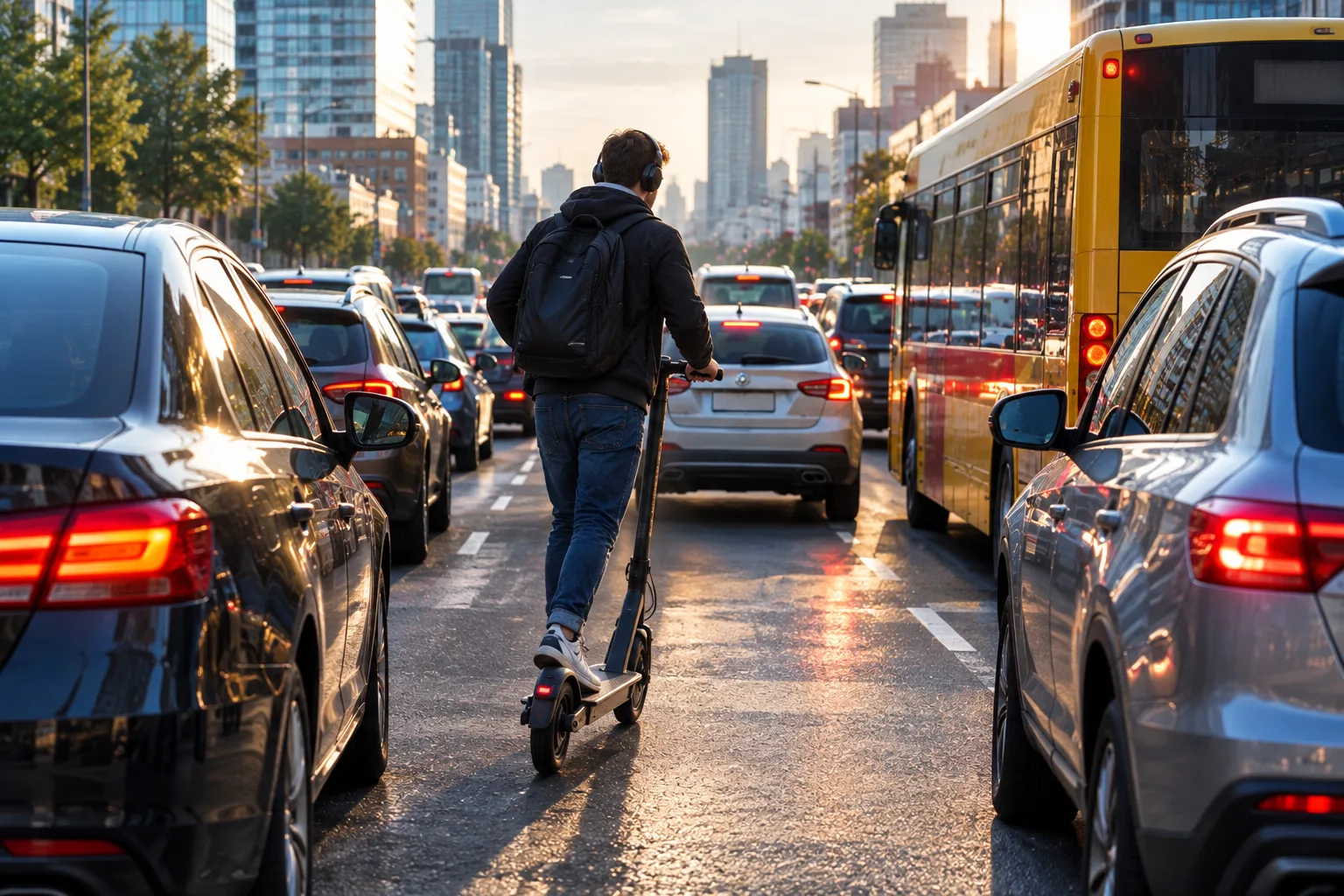
Electric scooters and other compact electric devices have become a routine part of mobility in Ukrainian cities. They fill the gap between walking and conventional public transport, offering inexpensive and flexible travel for short journeys. Their rapid adoption, however, has also produced recurring disputes over whether riders belong on pavements, cycle lanes or the roadway.
Bill No. 3023 attempts to replace that uncertainty with a defined legal framework. Rather than treating every electrically powered device as a motorcycle or leaving its rider in a grey area, the proposal introduces users of personal light electric transport as a separate category of road participant. That status would carry both rights and enforceable responsibilities.
Despite the popular question suggested by the debate, the supplied version of the bill does not create a driving-licence requirement for an electric scooter. It contains no mandatory riding test, registration plate or general state registration procedure for the devices covered by its definition. The proposed model is therefore based on regulating conduct, not licensing access.
The category would include people travelling on one-, two- or three-wheeled mechanically propelled devices powered by an electric motor. Electric scooters, Segways, hoverboards and similar equipment are listed as examples. Wheelchairs and electrically assisted bicycles are excluded from the definition in the quoted draft, meaning that their legal treatment would continue to be determined under other provisions.
The proposal gives these users access to dedicated cycling infrastructure. Where no cycle path is available, they could travel along the edge of the carriageway or on the shoulder, moving in the same direction as the general traffic flow. This resembles the position assigned to cyclists, but it does not make scooter riders legally identical to cyclists in every respect.
The intended principle is that pavements should remain primarily pedestrian space. That responds to one of the most visible sources of tension: fast-moving rental scooters passing close to pedestrians near transit stops, shops and residential entrances. Yet the precise treatment of pavement riding, crossings and pedestrian areas will require detailed and internally consistent provisions in the Traffic Rules.
Roadworthiness would become an explicit responsibility of the rider. A device would need to be technically sound and properly equipped with reflectors and, where its design permits, an audible warning signal. In darkness or poor visibility, a headlamp or other forward light would have to be switched on. These are basic requirements, but they address a serious problem because compact devices can be difficult for motorists to detect.
The rider would also need reflective elements on outer clothing or another visible location in low-light conditions. That requirement recognises the physical limitations of scooters: their lights are often small and positioned close to the ground, while the rider may blend into the background. Visibility becomes especially important at intersections, on poorly lit streets and beyond built-up areas.
The bill expressly prohibits riding while intoxicated by alcohol or drugs, or while affected by medication that reduces attention and reaction speed. This provision challenges the mistaken assumption that using a scooter after drinking is a harmless substitute for driving. A scooter offers almost no physical protection, and small wheels are particularly vulnerable to potholes, tram tracks and abrupt changes in the road surface.
Using a handheld phone or communication device while moving would also be prohibited. Navigation would not necessarily be impossible, but riders would need to rely on a safely mounted device or audio directions rather than holding a phone. Passengers could be carried only where the manufacturer has designed the vehicle for that purpose, which would rule out two-person rides on most standard rental scooters.
The proposal also extends administrative liability to this new group of road users by amending Article 127 of Ukraine’s Code of Administrative Offences. The purpose is to move the rules beyond voluntary guidance and give police a direct legal basis for responding to violations. In practice, enforcement would still require clear procedures, proportionate penalties and consistent identification of the devices covered.
Classification is likely to be one of the most difficult issues. Electric devices vary widely in weight, motor output and maximum speed: a low-powered standing scooter poses a different risk from a heavy machine capable of travelling at moped-like speeds. If legal definitions are too broad, dissimilar vehicles may be regulated in the same way; if they are too narrow, manufacturers and users may find themselves outside the intended framework.
Government descriptions of the initiative refer more broadly to age thresholds, speed limits, restrictions on high-speed roads and obligations for rental operators. These include maintaining fleets, arranging insurance and applying software-based speed controls. Such measures are not fully set out in the supplied legislative wording, however, so they should not be presented as settled legal duties unless they appear in the final act or accompanying regulations.
Rental companies would nevertheless be central to implementation. They can use geofencing to slow vehicles in crowded areas, prevent parking in selected zones and provide safety information before a journey starts. Technology has limits, though: an operator cannot reliably stop every intoxicated ride, handheld-phone use or unsafe manoeuvre. Responsibility would remain divided between the company’s duty to provide a safe vehicle and the rider’s duty to obey traffic rules.
Municipal infrastructure will be equally important. Directing scooters away from pavements is credible only where people have a reasonably safe alternative. Fragmented cycle lanes that end suddenly, damaged road edges and junctions designed solely for cars can push riders back into pedestrian space. Regulation without connected infrastructure may clarify liability after a collision without doing enough to prevent one.
Bill No. 3023 therefore represents an effort to normalise light electric mobility rather than ban it. In the version provided, riders would not need a driving licence, but they would be expected to use designated parts of the road, remain sober and attentive, maintain visibility and avoid carrying unauthorised passengers. Whether that framework improves safety will depend on the final wording, amendments to the Traffic Rules, public awareness and the ability of cities to provide routes on which compliance is practical.