
Seventh IROSA Array Deployed Outside the ISS
Anil Menon and Joshua Kutryk completed a 7-hour, 11-minute spacewalk to add another roll-out solar array to the International Space Station. One final installation is planned to complete the power augmentation project.
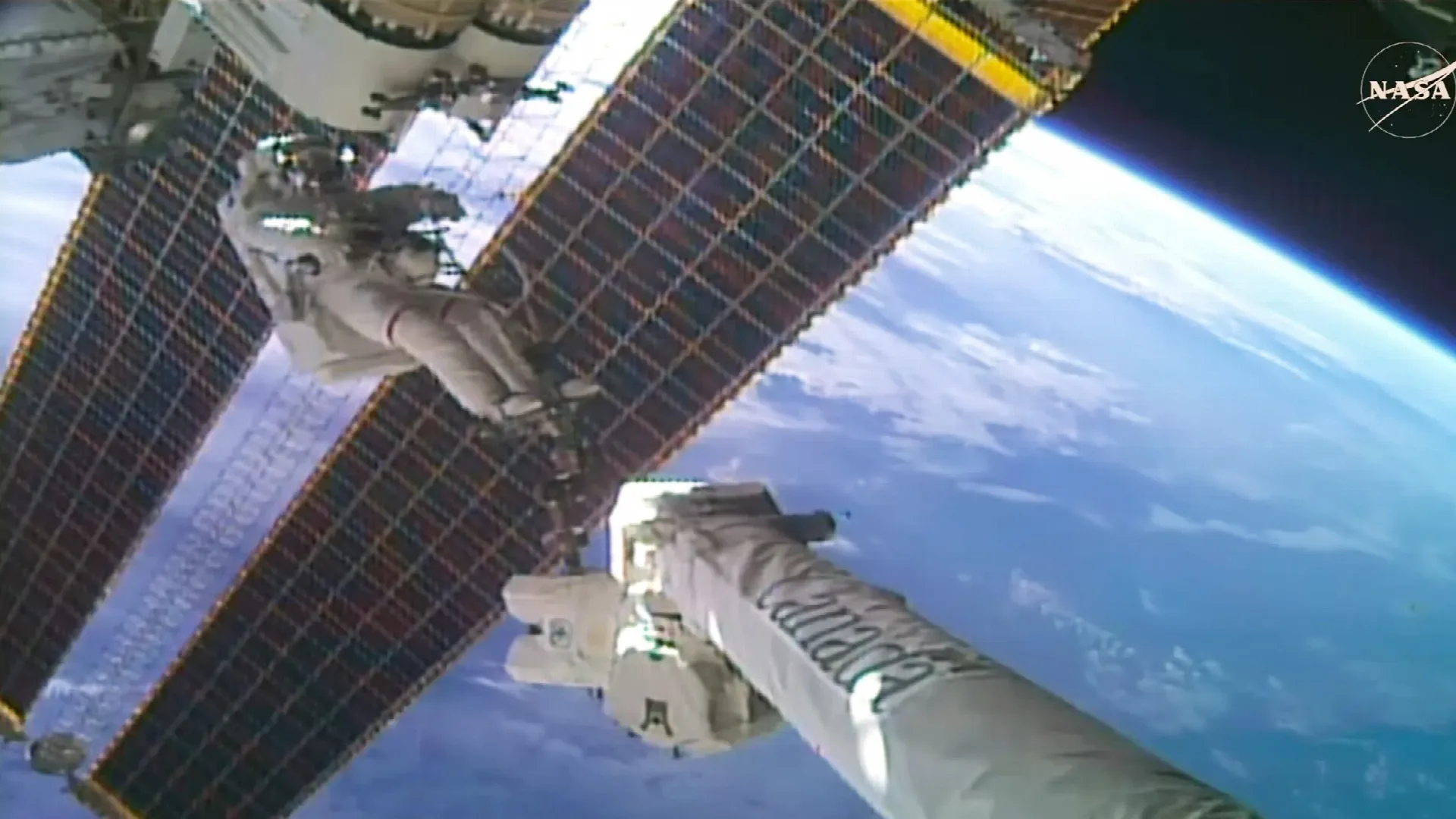
NASA astronaut Anil Menon and Canadian Space Agency astronaut Joshua Kutryk returned from a 7-hour, 11-minute spacewalk after installing and deploying a new roll-out solar array outside the International Space Station. The excursion ended at 3:08 p.m. EDT.
NASA Blogs reported the operation on Thursday, October 29. The astronauts’ principal assignment was an International Space Station Roll-Out Solar Array, or IROSA, designated for the orbital laboratory’s 2A electrical power channel.
The newly deployed unit is the seventh IROSA fitted to the station. Its addition brings the multistage power upgrade within one array of the planned eight-unit configuration.
Installation was only part of the task. Menon and Kutryk also deployed the array, placing the roll-out structure into the configuration required for it to contribute to the station’s electrical system.
NASA says the added generation will support critical operations aboard the ISS. Among the stated requirements is the power needed to help enable an eventual safe and controlled deorbit of the station.
That purpose gives the project a longer horizon than routine day-to-day electricity demand. The augmentation is intended both to strengthen available power and to support operations associated with the station’s future disposition.
Before ending the spacewalk, the astronauts completed several get-ahead tasks for a second excursion planned for Thursday, November 5. Such advance work was intended to prepare the worksite for installation of the remaining array.
The November 5 plan calls for the eighth and final IROSA to be installed on the 3B power channel. NASA scheduled live coverage to begin at 6:45 a.m. through its NASA Live service.
Completion of that spacewalk would mark the end of the station’s planned power-system augmentation. NASA describes the eight roll-out arrays as a combined package rather than isolated additions, with their full benefit measured across the completed set.
Together, the arrays are expected to increase available electrical power by as much as 30%. The station’s generating capacity is projected to rise from 160 kilowatts to approximately 215 kilowatts once all eight units are in place.
The excursion also carried different personal significance for the two crew members. It was Menon’s fourth spacewalk, while Kutryk was making his first venture outside the station.
NASA identified the activity as U.S. spacewalk 100. In the broader history of the ISS program, it was the 285th spacewalk conducted in support of station assembly, maintenance and upgrades.
The operation therefore combined an immediate engineering accomplishment with preparation for the next major task. Seven IROSA units had been installed by the end of the October 29 spacewalk, while the final step remained scheduled for November 5 on channel 3B.