
ISS Crew Links Bioprinting Research With Power-System Preparations
Expedition 75 used microgravity to study vascular tissue, cancer cells and exercise mechanics while preparing equipment for two planned spacewalks. The day’s work illustrated the station’s dual role as a biomedical laboratory and an engineering test bed.
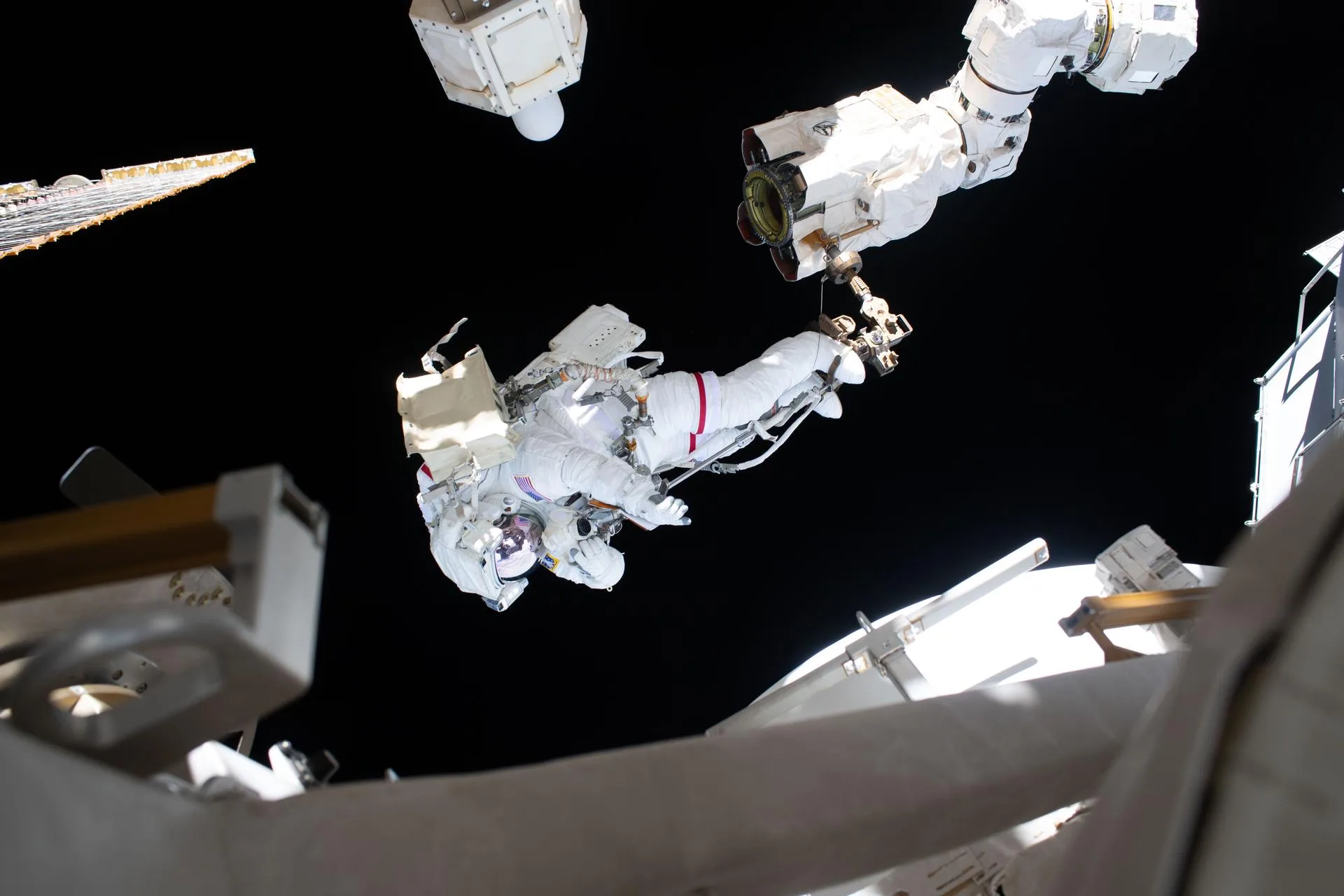
Expedition 75 devoted October 20 to a broad program of human-health research aboard the International Space Station, moving between cellular printing, tumor-sample processing and an instrumented exercise session. At the same time, crew members inspected the tools and safety equipment intended for two upcoming spacewalks tied to the outpost’s electrical-power upgrades.
NASA Blogs reported the activities on Tuesday, October 20. The work brought together investigations aimed at patients on Earth, measures designed to protect astronauts during long missions, and preparations for maintaining the station’s underlying infrastructure.
NASA flight engineers Luke Delaney and Jessica Watkins began with vascular-cell work in the Columbus laboratory module. Using the BioFabrication Facility, they removed samples from an incubator, processed the material with bioink and prepared it for printing into blood-vessel structures. The resulting specimens were then placed in a science freezer so their condition could be preserved for later examination.
Bioprinting in orbit is of interest because gravity complicates the production of delicate, three-dimensional biological structures on Earth. Soft materials can sag, cells can settle, and a developing construct may require supporting frameworks that influence its final form. In microgravity, researchers can investigate how cells assemble when their own weight is no longer a dominant force.
NASA said vascular cells printed in weightlessness can be markedly superior to counterparts produced on the ground. The wider ambition is to learn how functional human tissues, and eventually more complex organ-like structures, might be engineered for patient care. The station work nevertheless remained part of a research process: the samples were preserved, and the source did not describe a finished transplantable product or a clinical treatment.
Delaney later shifted to cancer research in the Japanese Kibo module. He handled tumor samples inside the Life Science Glovebox, an enclosed workspace suited to controlled biological procedures, before preserving them for analysis on Earth. Returning specimens to terrestrial laboratories allows investigators to apply equipment and methods that cannot all be accommodated aboard the station.
The cancer study examined how malignant cells grow and respond to treatments in weightlessness. Changes observed in orbit may help scientists separate cellular and genetic influences that are less obvious under normal gravity. NASA said the knowledge could potentially contribute to more targeted and efficient therapies, but no treatment outcome or confirmed medical breakthrough was reported.
Canadian Space Agency flight engineer Joshua Kutryk approached human health from another direction: the mechanics of exercise in space. He trained on the advanced resistive exercise device in the Tranquility module. Rather than relying on the weight of conventional gym equipment, the machine creates resistance that mimics some of the forces experienced when lifting free weights on Earth.
A motion-capture system recorded Kutryk’s movements while markers running from his hips to his feet tracked the lower body. The resulting measurements can show how exercise form changes in a spacecraft and help researchers assess whether a workout is producing the intended loading. NASA said the findings may support more effective in-flight exercise and could also have applications in sports technology on Earth.
Elsewhere, NASA flight engineer Anil Menon worked in the Quest airlock, configuring tools and examining tethers for use with Kutryk outside the station. Their spacewalks were scheduled for October 29 and November 5, dates that were still ahead as of October 23. The source described the missions as planned and did not state that either had yet taken place.
During the two excursions, Menon and Kutryk were expected to install roll-out solar arrays on the station’s truss and complete the associated power-generation upgrade. Gaurang Patel, NASA Low Earth Orbit Program operations integration manager, said at a preview briefing that the arrays could increase generation capability by as much as 30 percent. The figure described the upgrade’s intended capacity benefit, not a result already documented in the source.
The station’s Russian crew members carried out a separate mix of Earth observation, training and logistics. Commander Pyotr Dubrov positioned a camera at a Zvezda service-module window for automated, multiwavelength photography of African landmarks. Sergey Teteryatnikov practiced European robotic arm operations on a laptop, while Anna Kikina transferred water from the Progress 96 cargo vehicle into station tanks. Together, the assignments showed how biomedical research depends on a continuing foundation of power, supplies, technical proficiency and routine maintenance.