
Dragon begins 35th NASA resupply flight with 6,300 pounds aboard
A SpaceX cargo spacecraft launched from Cape Canaveral on October 13 carrying science investigations and station supplies. Its published schedule called for arrival at the International Space Station two days later.
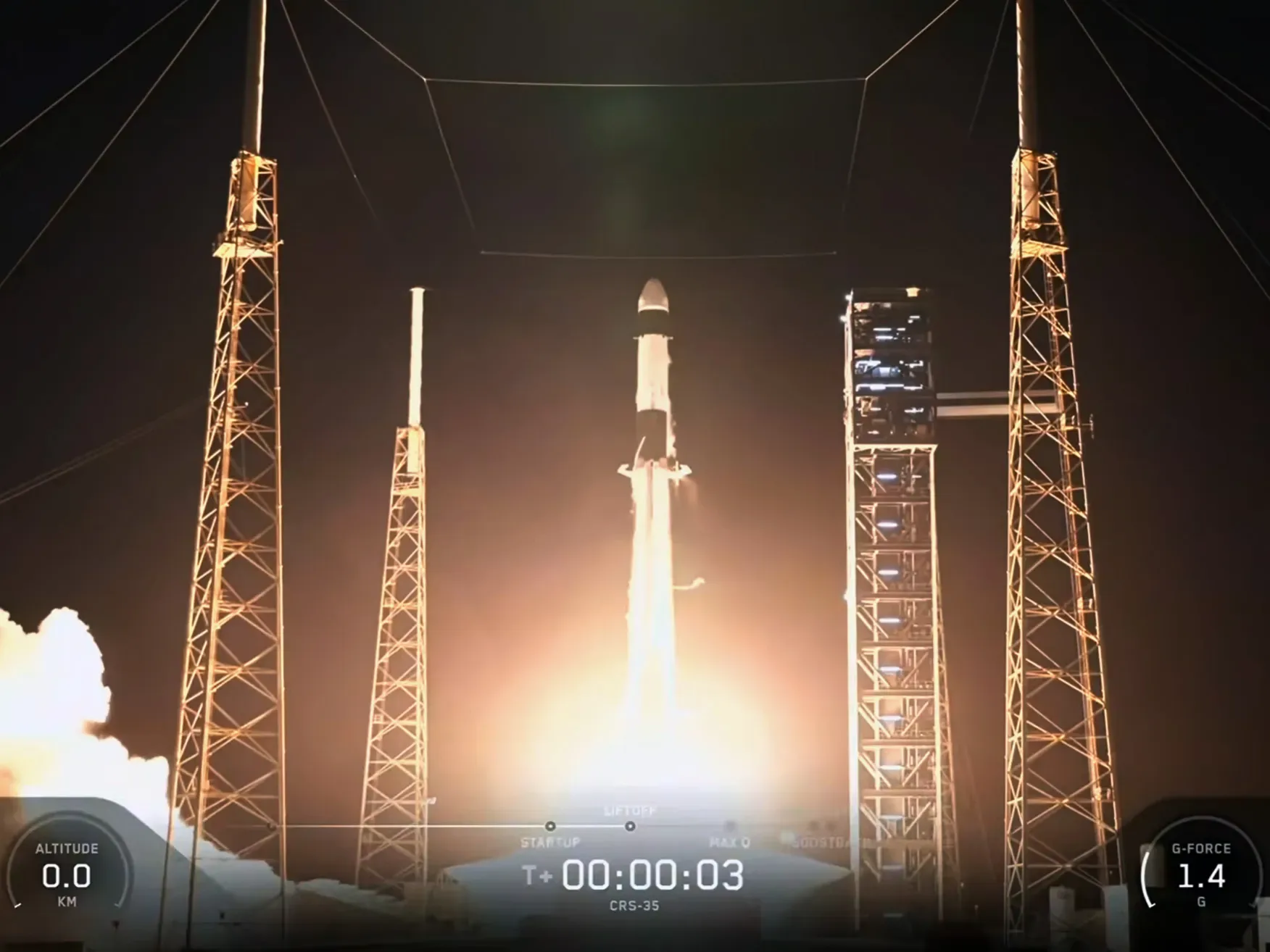
SpaceX’s Dragon cargo spacecraft lifted off at 6:33 a.m. EDT on October 13 with more than 6,300 pounds of scientific investigations and other cargo bound for the International Space Station. The flight was identified as SpaceX’s 35th commercial resupply services mission for NASA.
NASA Blogs reported the launch on Tuesday, October 13. That initial account covered Dragon’s departure and early orbital operations but did not establish the eventual outcome of the rendezvous and docking sequence planned for later in the week.
The mission began at Space Launch Complex 40 at Cape Canaveral Space Force Station in Florida. A Falcon 9 rocket carried Dragon away from the launch site and through the powered ascent needed to place the cargo vehicle on a trajectory from which it could begin pursuing the orbiting laboratory.
Roughly nine minutes after liftoff, Dragon separated from the Falcon 9 second stage. The milestone marked the end of the launcher’s principal role and the start of the spacecraft’s independent journey, during which Dragon relied on its own navigation, propulsion, communications and power systems.
Dragon then opened its nosecone, exposing the area used during the station approach and docking process. The cone protects sensitive hardware during the high-speed passage through the atmosphere, but must be moved out of the way before the spacecraft can complete its connection with the ISS.
After separation, the vehicle began what NASA described as a carefully choreographed series of thruster firings. Rather than heading toward the station in a straight line, a visiting spacecraft must reshape its orbit in stages, gradually adjusting its altitude, velocity and position relative to a destination that is itself circling Earth at orbital speed.
The schedule published on October 13 called for Dragon to reach the station at approximately 11 a.m. EDT on Thursday, October 15. Because that date had passed by October 21, it represents the mission plan announced before arrival, not evidence in the cited update that docking occurred at the projected time.
NASA had also planned to begin live rendezvous and docking coverage at 9:15 a.m. on October 15. The agency directed viewers to NASA Live and said coverage would be available across several platforms, reflecting the public interest in the precise final phase of a cargo vehicle’s approach.
Cargo runs are essential to keeping the ISS functioning as both an inhabited outpost and an orbital laboratory. They support a broad chain of activity extending from researchers and payload teams on Earth to astronauts who install experiments, maintain equipment and manage limited storage aboard the station.
NASA’s brief launch notice did not itemize the investigations aboard Dragon or specify how the total mass was divided among scientific payloads, hardware and other supplies. The figure of more than 6,300 pounds therefore conveys the overall size of the shipment without showing which projects or categories accounted for most of it.
Calling the flight the 35th commercial resupply services mission also places it within a long-running operational relationship. Under that approach, NASA obtains station transportation as a contracted service, while SpaceX provides the launch vehicle, cargo spacecraft and associated mission operations required to move supplies between Earth and orbit.
The interval between launch and the planned Thursday arrival was not idle travel time. It allowed Dragon to perform successive burns, refine its path and approach the ISS through tightly controlled corridors. During the closing phase, relative motion matters more than raw speed: the spacecraft must reduce the difference between its own path and the station’s with considerable precision.
A successful liftoff is consequently only one checkpoint in a cargo mission. Separation, orbital maneuvering, navigation and docking each present distinct operational demands, and NASA’s October 13 post confirmed only the early milestones it described. It did not provide a retrospective account of the later arrival.
NASA encouraged readers seeking subsequent information to follow the space station blog, the @space_station account on X, and the ISS pages on Facebook and Instagram. The original update therefore serves primarily as a record of Dragon’s launch with a substantial scientific and logistical load, together with the timetable that mission teams expected to follow.