
Ukraine bill seeks legal certainty for past energy procurement amendments
Draft law No. 16127-1 would validate a narrowly defined group of price adjustments made to public energy contracts after January 2021. Its passage would reopen a difficult debate over legitimate expectations, retroactivity and the finality of court judgments.
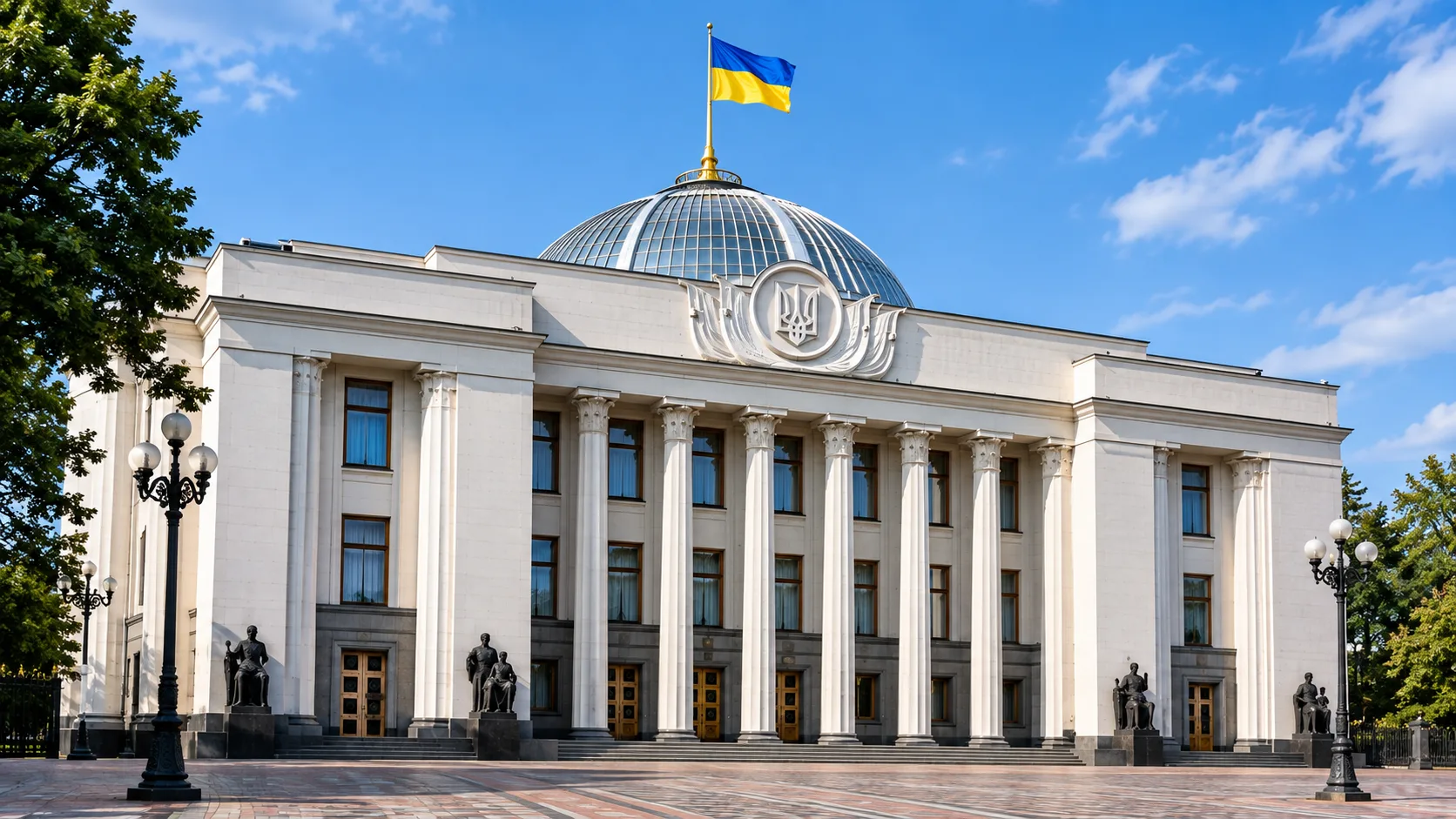
A new alternative bill before Ukraine’s parliament seeks to settle the status of contract amendments used to adjust prices for natural gas, electricity, petrol and diesel purchased by public bodies after the beginning of 2021. The proposal addresses agreements signed during a period of sharp market volatility but later exposed to litigation after the Supreme Court adopted a stricter interpretation of the procurement rules.
The Verkhovna Rada of Ukraine reported the filing on Wednesday, October 14, 2026. Registered as bill No. 16127-1 on October 13 and introduced by MP Liudmyla Buimister, it is an alternative to government bill No. 16127 and has been assigned primarily to the Committee on Economic Development.
At the centre of the dispute is a former provision of the public procurement law permitting the unit price of a good to rise by up to 10 percent in proportion to a documented market increase, provided the total value of the contract remained unchanged. The wording left room for two materially different readings: a single cumulative ceiling of 10 percent for the life of the contract, or a 10 percent limit applicable to each separate adjustment prompted by a new market fluctuation.
For years, contracting authorities and suppliers commonly relied on the latter approach. Guidance issued by the competent procurement authorities in 2014, 2016, 2019 and 2020 indicated that repeated adjustments could be made if each was supported by market evidence and did not increase the overall contract amount. In practical terms, a buyer would often receive a smaller quantity within the same budget while the supplier avoided continuing deliveries at a price that no longer reflected market costs.
That mechanism became particularly important during the electricity price shock of 2021. According to figures cited in the explanatory memorandum, the weighted average day-ahead market price in Ukraine’s integrated power system rose from UAH 1,481.31 per MWh excluding VAT in January to UAH 3,160.17 in December. The roughly 113 percent increase meant that contracts awarded early in the year could become commercially unsustainable long before their scheduled expiry.
The legal landscape shifted with a January 24, 2024 judgment of the Grand Chamber of the Supreme Court in case No. 922/2321/22. The court held that parties could amend a price more than once, but the aggregate increase in the unit price over the full contract term could not exceed 10 percent of the original figure. The Grand Chamber repeated the same essential approach in a November 2025 ruling in case No. 920/19/24.
This created a clash between earlier administrative guidance and later judicial interpretation. Prosecutors subsequently brought claims seeking to invalidate some amendments and recover money paid for energy or fuel that had already been delivered and consumed. The explanatory note also says that amendments became a basis for criminal investigations involving officials of contracting authorities and suppliers, even where the changes had been published and supported by price data.
Bill No. 16127-1 would not validate every historical price increase. Protection would apply only where several conditions were met simultaneously: the amendment was concluded after January 1, 2021; it concerned one of the four specified energy products; it responded to an actual market movement; the unit-price change remained within the relevant statutory mechanism; and the contract’s total value did not rise.
Where those tests are satisfied, signing the amendment would not itself constitute a procurement violation, trigger liability, justify a finding that the agreement was void, or support recovery of payments made under it. The distinction is important because the proposal does not excuse document forgery, collusion, corruption, misappropriation, conflicts of interest or other independently established offences. Evidence of the market fluctuation and the link between that movement and the price adjustment would still be required.
The draft also protects the finality of completed cases. It would not apply where a court judgment had already become final before the law entered into force, nor would it require repayment of money already returned or recovered. As a result, similarly situated suppliers could face different outcomes depending on whether proceedings against them had concluded before the effective date, a boundary intended to preserve res judicata but likely to attract debate over equal treatment.
The constitutional issue is equally significant. Ukraine’s Constitution generally prohibits retroactive legislation but allows retroactivity for rules that abolish or mitigate a person’s liability. The sponsor argues that the proposed provision falls within that exception because it removes adverse consequences for parties that relied in good faith on the law and official guidance. Opponents may question whether civil restitution and invalidity are forms of liability for this purpose, and whether parliament should alter the legal framework governing pending disputes.
The government’s original bill No. 16127 takes a more limited route by proposing to delete the disputed transitional clause in response to constitutional and civil-law concerns. Buimister’s alternative argues that deletion alone would leave the underlying problem untouched: historical agreements would continue to be judged under case law developed years after they were signed, without a specific statutory instruction to account for the state’s earlier guidance.
Supporters also frame the measure as a safeguard for continuity of essential services. Large recoveries could weaken suppliers, lead to insolvency or cause other supply contracts to be terminated. Hospitals, schools, military units, water utilities and district-heating facilities might then have to rely on a supplier of last resort, whose regulated pricing formula can impose higher costs and introduce uncertainty for public budgets.
The countervailing concern is procurement integrity. A fixed total contract price does not necessarily eliminate economic harm if repeated unit-price increases sharply reduce the quantity delivered, forcing the authority to launch another purchase sooner than expected. Parliamentary scrutiny is therefore likely to focus on what evidence qualifies as proof of a market fluctuation, how proportionality should be measured, and whether the provision could shield opportunistic amendments alongside genuinely unavoidable ones.
In addition to the Economic Development Committee, the bill has been referred to committees responsible for legal policy, energy, finance, the budget, anti-corruption policy and European integration. Their assessments will determine whether the proposed criteria are sufficiently objective and whether the balance struck between legal certainty, public finance protection and judicial finality can withstand constitutional review.
If adopted in its current form, the law would take effect on the day after publication. Its real impact would then depend less on the declaration that qualifying amendments are lawful than on the discipline with which courts and enforcement bodies apply every condition. The central challenge is to protect good-faith reliance on official rules without turning a targeted transitional remedy into blanket immunity for questionable public-contract price changes.