
Crew-12 Dragon commits to its return after deorbit burn
SpaceX’s Dragon spacecraft has completed the planned deorbit burn with four international crew members aboard. The capsule still had to negotiate atmospheric entry, parachute deployment and recovery at sea before the homecoming could be declared complete.
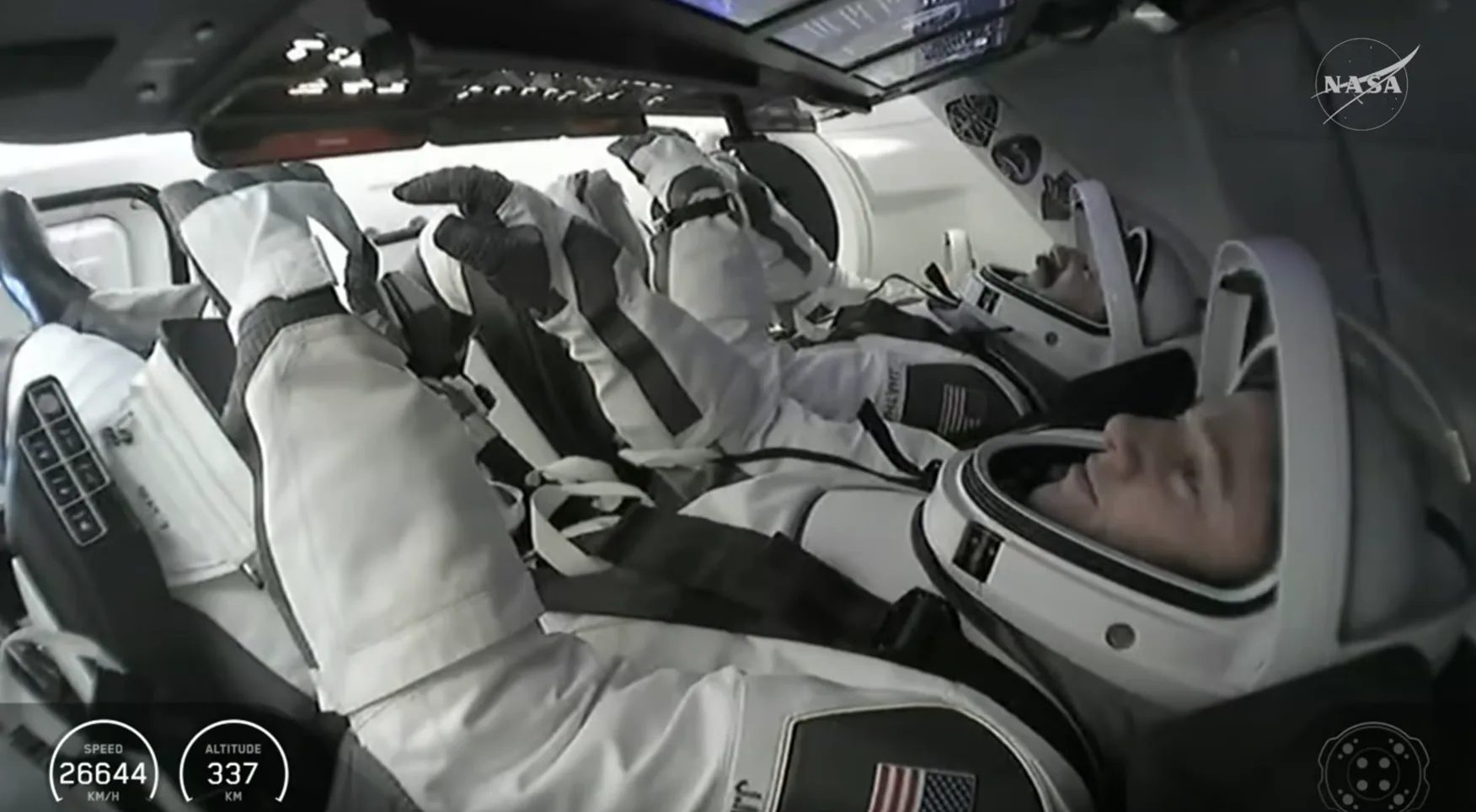
The SpaceX Dragon carrying NASA astronauts Jessica Meir and Jack Hathaway, ESA astronaut Sophie Adenot and Roscosmos cosmonaut Andrey Fedyaev completed its deorbit burn as expected, moving NASA’s Crew-12 return into its most consequential phase. The maneuver placed the capsule on the trajectory required for atmospheric entry and eventual splashdown.
NASA Blogs reported the milestone on Thursday, October 8, 2026. NASA made live coverage available across several platforms and directed viewers to nasa.gov/live for the return broadcast.
A deorbit burn is relatively brief compared with an entire orbital mission, but it carries outsized importance. By firing its thrusters in a carefully calculated orientation, Dragon reduces enough orbital velocity to lower its path into the atmosphere. Timing and precision are essential because the resulting trajectory must remain within a narrow entry corridor.
Completion of the burn is therefore a major commitment point rather than the end of the journey. Dragon must still survive intense heating as atmospheric drag converts much of its kinetic energy into heat. Its thermal protection system shields the pressure vessel and the four people inside while the capsule rapidly decelerates.
Near the end of the descent, the spacecraft relies on two sets of parachutes. NASA said the drogue chutes were due to deploy about four minutes before splashdown at roughly 18,000 feet, when Dragon would still be moving at approximately 350 mph. That is about 5.5 kilometers in altitude and 560 kilometers per hour.
Less than a minute later, the main parachutes were expected to deploy at about 6,000 feet, with the capsule traveling near 120 mph. The four main canopies provide the large braking surface needed for the final descent, reducing the spacecraft to a much lower speed before it reaches the water.
The staggered sequence is designed to manage forces rather than stop the capsule abruptly. Drogue parachutes help stabilize its attitude and remove speed before the much larger main canopies inflate. Mission controllers use telemetry to verify that deployment events occur in the intended order and that the descent rate develops within acceptable limits.
Parachutes are only one part of the recovery equation. Teams also have to account for winds, waves, visibility and the ability of ships and helicopters to operate safely near the landing area. Conditions at sea can affect how quickly personnel reach Dragon even when the spacecraft itself performs normally.
Once the capsule splashes down, recovery crews are tasked with approaching and securing it before it is brought aboard a vessel. Specialists then open the hatch and assist the astronauts out of the cabin. That assistance matters because returning crew members can feel weak or disoriented as their bodies readjust to gravity after time in microgravity.
Crew-12’s manifest reflects the international structure of human spaceflight in low Earth orbit. The NASA, ESA and Roscosmos personnel return in one American commercial spacecraft, requiring coordination among the spacecraft operator, the US agency and international partners. The recovery also involves medical and technical teams whose work continues after the live broadcast’s most visible moments.
Dragon operates under NASA’s Commercial Crew framework, an approach in which the agency purchases crew transportation from private providers while retaining safety oversight and mission requirements. SpaceX runs the spacecraft and associated operational systems, while NASA monitors performance and participates in decisions across launch, orbital flight and return.
Public coverage offers a window into a sequence that is both highly rehearsed and sensitive to changing conditions. Apparent gaps in video or communications do not by themselves indicate a problem, as vehicle geometry and relay availability can affect the flow of live information. Controllers rely primarily on spacecraft telemetry rather than broadcast images.
The nominal deorbit burn gave Crew-12 the required start to its descent, but mission success would not be fully established until splashdown, capsule safing and crew extraction. Until then, each milestone—from atmospheric entry to parachute inflation and shipboard recovery—remained part of a tightly managed chain intended to bring all four travelers safely home.