
Prescribed fire sharply improves giant sequoias’ odds in extreme wildfires
A NASA-funded analysis found that giant sequoias in previously treated forests were nearly four times more likely to survive severe fires. The findings provide rare quantitative evidence for a practice long supported by forest managers.
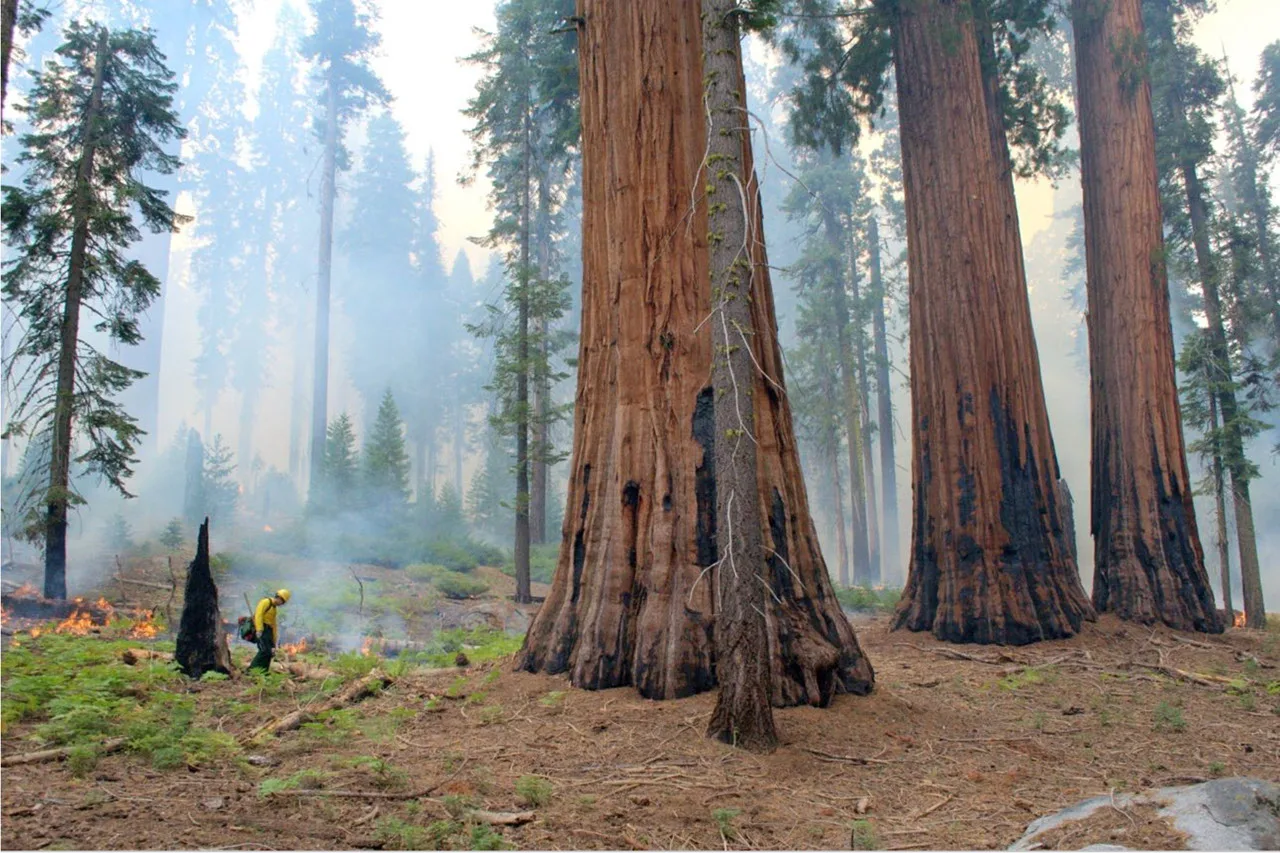
Giant sequoias exposed to extreme wildfire were nearly four times more likely to survive when their surrounding forests had previously been treated with prescribed fire, according to a NASA-funded study. The analysis offers a measurable estimate of how planned burning can protect one of the world’s largest and longest-lived tree species as California confronts increasingly destructive fire seasons.
NASA Blogs reported the findings on Monday, July 20. The underlying research, published July 11 in Nature Communications, examined the aftermath of the 2020 and 2021 fire seasons in Sequoia and Kings Canyon National Parks.
Researchers assessed 26,403 giant sequoias across 19 groves, bringing together lidar measurements, mapped tree stems, high-resolution imagery and statistical modeling. That combination allowed the team to connect mortality patterns with the way individual forest areas had been managed before fire arrived, rather than relying only on broad maps of burned acreage.
The study estimated that prescribed burning saved roughly 1,800 giant sequoias. Although land managers have long regarded planned fire as one of the strongest tools for protecting sequoia groves, much of the support had rested on experience and observations from particular sites. The new work assigns a species-specific number to that benefit across a large sample of trees and multiple groves.
Giant sequoias occur naturally only in scattered groves along the western slopes of California’s Sierra Nevada. They can exceed 300 feet in height and 30 feet in diameter, and some persist for thousands of years. Their thick bark helps insulate living tissue, while mature crowns often stand above lower flames, adaptations that reflect a long relationship with periodic fire.
That relationship does not make the trees invulnerable. Historically, frequent fires of low or moderate intensity consumed fallen branches, shrubs and young trees before those fuels could accumulate. Decades of aggressive fire exclusion altered many forests, leaving denser vegetation and larger quantities of dry material that can carry flames upward and expose even massive sequoias to prolonged heat.
Prescribed burns are designed to interrupt that process under controlled conditions. Crews establish boundaries and ignite selected areas only when wind, humidity, temperature and fuel moisture fit an approved plan. By consuming understory plants and dead wood in advance, the treatment can reduce the energy available to a later wildfire and make crown fire less likely.
The urgency became clear during 2020 and 2021, when a record 6.8 million acres burned across California. Across the giant sequoia’s range, an estimated 19% of the mature population was destroyed during those two years. Because an ancient tree cannot be replaced on a human timescale, the loss represented far more than a temporary decline in forest cover.
Large sequoias function as ecosystem anchors. They store substantial amounts of carbon, influence watershed processes and provide complex vertical habitat for birds, insects and small mammals. When old trees die in large numbers, their carbon may gradually return to the atmosphere, and the physical structure on which other organisms depend can take centuries to re-form.
Planned fire nevertheless involves trade-offs. Smoke can affect nearby communities, particularly people with respiratory or cardiovascular conditions, and suitable burn windows may be brief. Agencies also need trained personnel, funding and coordination across jurisdictions. If weather shifts beyond the limits of a burn plan, an operation may have to be postponed or halted.
Fire specialists argue that those risks should be compared with the consequences of leaving heavy fuels untreated. A prescribed burn generally produces a lower-intensity fire at a chosen time, while an uncontrolled summer blaze may generate far more smoke, threaten communities and kill mature trees over a much larger area. Indigenous communities in California have also emphasized that purposeful burning is not a new invention; cultural fire was used for generations to shape resilient, productive landscapes before colonial authorities restricted the practice.
The NASA-backed project is notable for showing what remote sensing can contribute after a disaster. Lidar can reveal vegetation height and forest structure, while detailed imagery helps distinguish damaged crowns and surviving trees. When those observations are tied to stem maps and field knowledge, researchers can evaluate management outcomes at a resolution relevant to a particular species.
That approach could be applied beyond the Sierra Nevada. Old-growth forests around the world contain trees whose ecological importance cannot be captured by acreage alone. Species-level monitoring can show whether a treatment preserves the organisms of greatest conservation value, rather than merely changing the average severity recorded across a landscape.
The results do not imply that prescribed fire is sufficient in every grove or can be applied identically everywhere. Steep terrain, unusually dense fuels, nearby communities and changing weather may require mechanical thinning or removal of accumulated wood before burning. Treatments also need maintenance because shrubs and small trees grow back, gradually rebuilding the fuel layer.
The larger lesson is that fire-adapted forests still require active choices in an era of hotter droughts and more extreme burning conditions. NASA’s observational capabilities can identify where trees survived and why, but the protective effect depends on work carried out before the next emergency. For giant sequoias, the study suggests that restoring a more frequent, moderate role for fire may be essential to preventing rare groves from being transformed by catastrophic events.