
As Alligator Alcatraz Empties, Its Detention Model Is Already Moving Elsewhere
The Everglades immigration camp is being wound down under a court order after two turbulent months. Families’ accounts of illness, transfers and prolonged uncertainty reveal why the fight over the facility will outlast the compound itself.
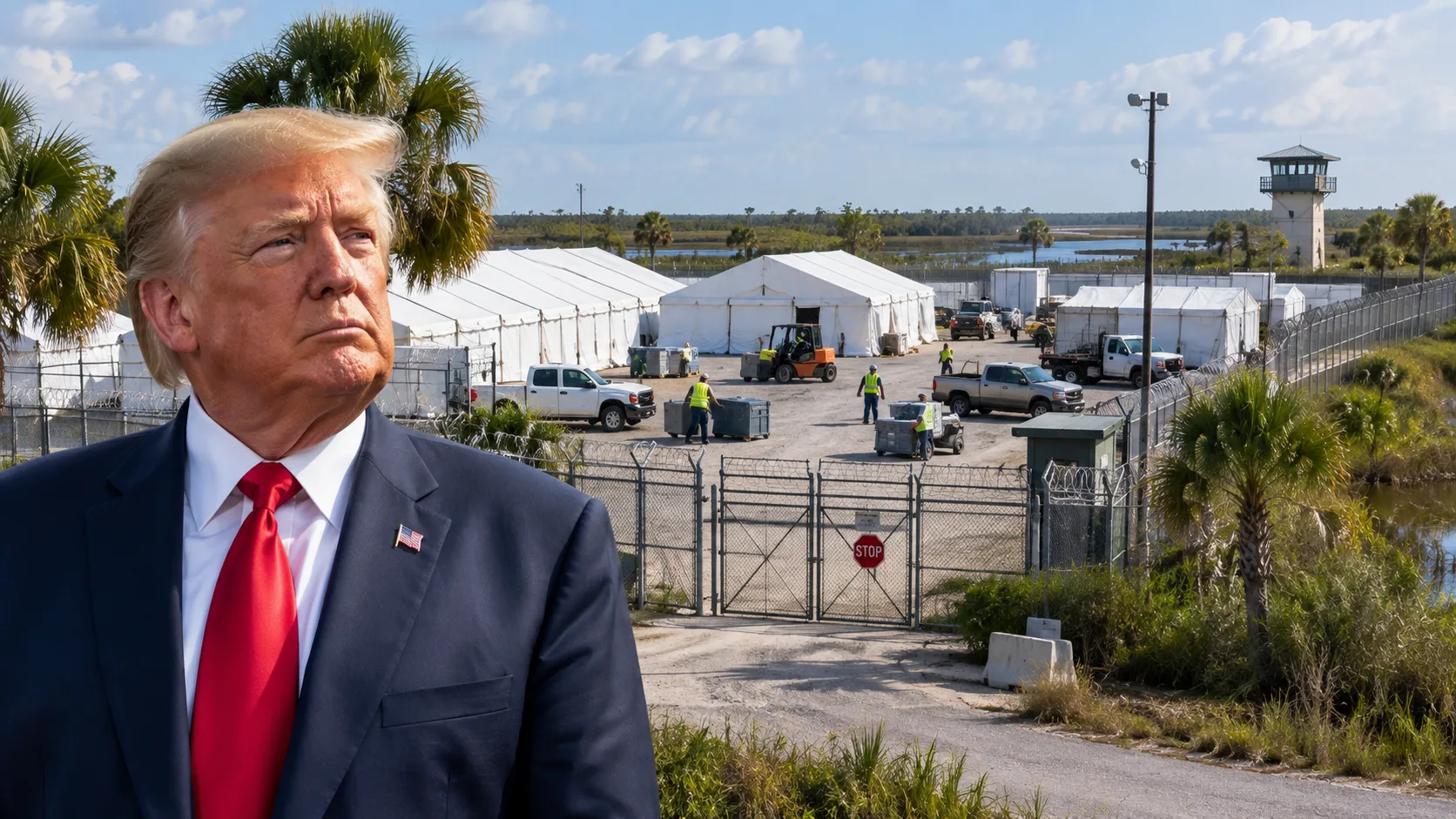
The dismantling of Alligator Alcatraz is unfolding almost as quickly as its construction. Raised in roughly eight days on an isolated airfield in the Florida Everglades, the temporary immigration detention center became a national political spectacle before its operating systems had been tested for long. Two months later, detainees are being transferred out as the government complies with a federal judge’s preliminary injunction.
Tom Homan, the Trump administration’s border policy chief, said only about half of the detainee population remained as the drawdown proceeded. The Department of Homeland Security is appealing the ruling but says it will follow the order requiring the site to close within 60 days. The underlying litigation argues that authorities failed to complete required procedures before establishing a detention complex in protected wetlands.
The center was designed for approximately 3,000 people but apparently never reached capacity. Its opening nevertheless coincided with a major expansion of immigration custody nationwide, with the detained population reaching a record of about 59,000 by mid-August. In that broader system, the Everglades site was not the largest institution. Its importance came from the speed of its creation, the theatrical language surrounding it and its role as a prototype for emergency detention capacity.
Its nickname transformed geography into a message. The surrounding marshes, populated by alligators and venomous snakes, were repeatedly invoked as if the landscape itself were part of the security perimeter. A prominent roadside sign made the label official in the public imagination, while Florida Republicans sold branded shirts, hats and drink coolers. Supporters arrived for photographs; demonstrators came to condemn what they regarded as the merchandising of confinement.
That split reflected the larger immigration argument in the United States. Backers of the facility said it showed that laws would finally be enforced and that people without legal permission to remain could be removed swiftly. Critics countered that the population entering immigration custody is not a single category: it includes people with removal orders, asylum applicants awaiting decisions, visa overstayers, long-term residents and individuals facing criminal allegations of widely varying seriousness.
The legal nature of immigration detention makes conditions inside especially consequential. Unlike a prison sentence imposed after conviction, civil detention is officially intended to ensure that a person appears for proceedings or removal. Lawyers therefore argue that unnecessarily harsh treatment cannot be justified as punishment. Access to medical care, hygiene, family communication and confidential legal advice is not peripheral to that distinction; it is central to whether the system remains genuinely non-punitive.
Officials and visitors offered sharply different portraits of the camp. Republican lawmakers who toured it in July described an orderly, safe and clean operation. Democrats called it crowded, unsanitary and degrading. Homan said he personally saw a well-maintained facility. Florida’s emergency management authorities have said detainees could obtain round-the-clock medical attention, use an on-site pharmacy and schedule virtual or face-to-face meetings with attorneys.
The experience described by the family of Cuban migrant Michael Borrego Fernandez is far darker. His mother, Yaneisy Fernandez, did not initially know where he had been taken. The first clear information came from Michael himself, who telephoned and referred to the place simply as the facility with crocodiles. That uncertainty — a relative entering custody, disappearing from ordinary contact and then resurfacing through a monitored call — became a recurring feature in accounts surrounding the camp.
Michael came to the United States in 2019 and received temporary political asylum, according to his mother. He later became entangled in a fraudulent hot-tub construction operation. A removal order followed, and in June he pleaded guilty to grand theft to avoid incarceration. Michael maintains that he did not know the company was defrauding customers; his lawyer also says he was unaware that a removal order had been issued against him.
Within days of his arrival at the Everglades compound, Yaneisy said, fellow detainees reported that Michael had awakened covered in blood. She said he was suffering from stage-four hemorrhoids, underwent colon surgery at a hospital and was then returned to the camp. During brief calls, he allegedly complained of severe pain, infection and inadequate medication. His mother also said he was restrained overnight in a position that prevented him from lying as doctors had advised and was denied timely access to a shower and clean underwear after bleeding and soiling himself.
DHS rejected the allegations as false and said immigration authorities provided appropriate treatment and medication. The competing accounts have not been independently resolved, and medical privacy limits public access to the records that might clarify them. Michael’s case now forms part of continuing litigation alleging that detainees were denied reliable, confidential, in-person access to counsel. The government says physical space was available for attorney meetings. He was transferred elsewhere on 1 August.
Another family’s ordeal centered less on conditions visible inside the camp than on the opacity of the transfer system. Marco Alvarez Bravo, a 38-year-old Chilean national, was stopped by immigration agents after leaving his Tallahassee home to prepare an estimate for a construction client. His wife, Gladys, said he had overstayed a tourist visa but had a pending asylum case that allowed him to remain while it was considered. The couple had married only 11 days before his arrest.
DHS alleged that Marco was a known member of a South American theft group. Gladys disputed that characterization and said her husband had no criminal record. The disagreement illustrates a persistent problem in public discussion of immigration enforcement: agencies may cite investigative intelligence or alleged affiliations that relatives cannot readily examine or challenge, while families often understand a person’s record through formal charges and convictions. Those different standards can produce irreconcilable descriptions of the same detainee.
For Gladys, the urgent issue was Marco’s health. She said he has Wolff-Parkinson-White syndrome, a condition that can cause episodes of abnormally rapid heartbeat, and had undergone a related procedure in April. He was taking daily medication and was still recovering from pneumonia when he was detained. After calling to report a ruptured kidney affecting his spine, he was reportedly seen in a wheelchair and taken to a hospital.
Then the communication stopped. For more than a week, Gladys could not locate Marco through ICE’s online detainee database and did not know whether he remained hospitalized, had returned to the Everglades or had been sent elsewhere. Immigration lawyers say such gaps in the locator system have become common. They cause obvious distress to relatives, but they also carry legal consequences by delaying consultations, filings and attempts to challenge transfers or removal decisions.
DHS said Marco was receiving medical care and was alert and able to call his family, though it did not initially give a specific location in response to questions. He finally contacted Gladys again on 22 August after returning to Alligator Alcatraz. Within days, another transfer was being prepared without either spouse knowing the destination. He later appeared to have been moved to the Krome detention center, roughly 35 miles away.
Cases like these complicate the official presentation of transfers as routine logistics. Moving detainees may be necessary when a temporary site closes, but every transfer also interrupts medical continuity, attorney access and family contact. A delayed database entry can turn an administrative movement into days of fear. For a person recovering from surgery or managing a heart disorder, incomplete records or missed medication can carry risks beyond inconvenience.
The environmental case that prompted the shutdown addresses a different form of institutional haste. The Everglades is a sensitive wetland system, and constructing a large compound there raises questions about water, waste, lighting, traffic and wildlife disturbance. Opponents say the government bypassed safeguards designed to assess those effects. Authorities maintain that extra detention space was urgently needed, framing the dispute as a conflict between procedural review and rapid enforcement capacity.
Even if the camp closes on schedule, the policy behind it is expanding. Florida is developing another temporary site nicknamed Deportation Depot, while officials in Indiana have promoted a facility called the Speedway Slammer. Homan described Alligator Alcatraz as a useful transitional installation rather than a long-term answer and said ICE requires more permanent brick-and-mortar capacity, backed by newly available funding.
The Everglades compound may therefore be remembered less as an isolated failure than as an early experiment in a larger detention buildout. Its short life exposed the political appeal of highly branded enforcement, the legal vulnerability of rushed construction and the human costs of a system in which detainees can become difficult to locate during their most medically fragile moments. The tents and barriers may soon disappear, but the core questions — who is confined, under what conditions, with what oversight and how quickly their families are told — are being carried into the next generation of facilities.