
Village and Farm Country: Ukraine and Rural America Compared
Ukraine’s village-centered countryside and America’s farm-and-small-town landscape grew from different systems of settlement, property and agricultural production. Their differences remain profound, yet both now confront depopulation, consolidation and the uneven promise of digital renewal.
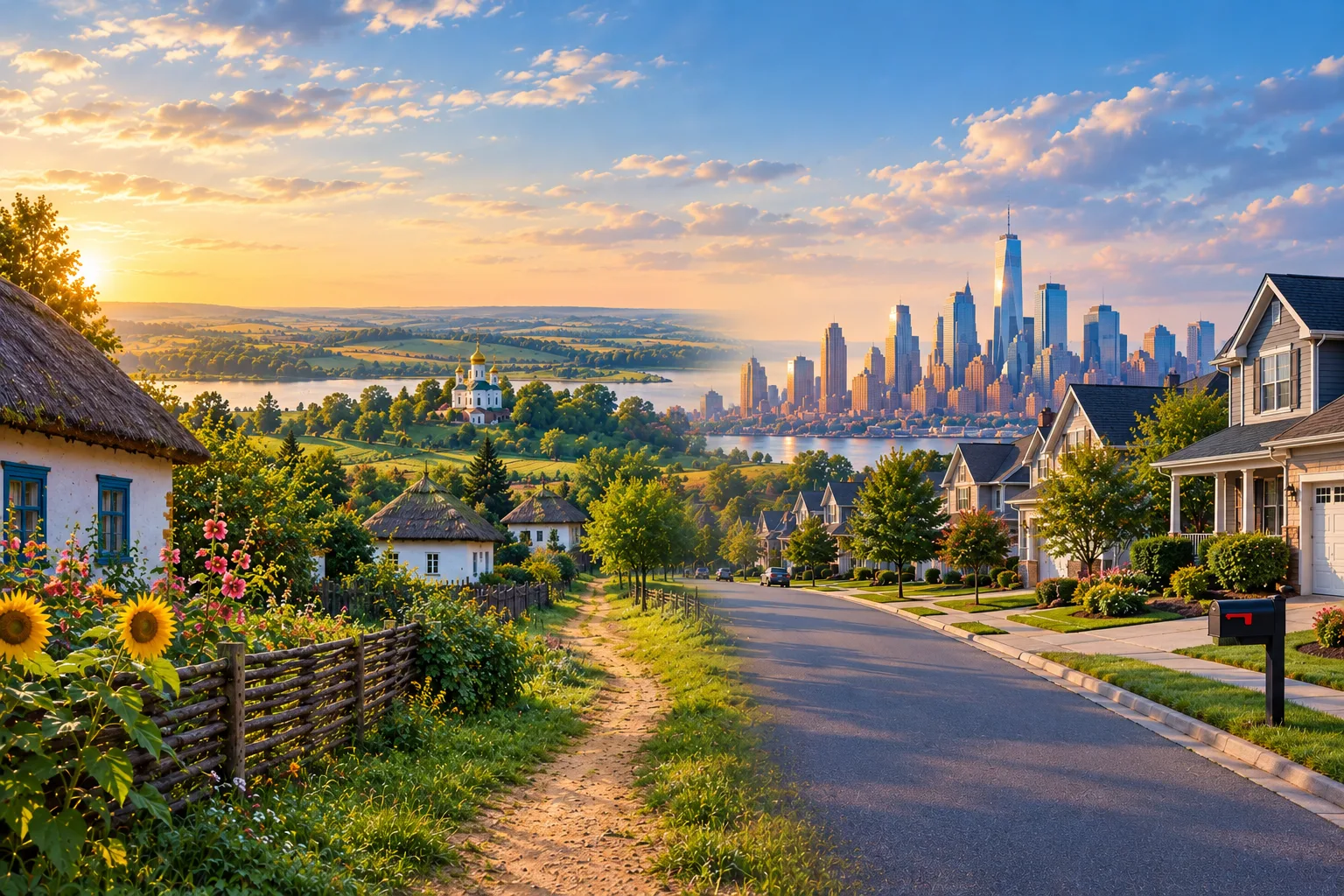
A Ukrainian village and an American farming district may both be surrounded by cultivated land, but they are not equivalent social units. The Ukrainian term usually points to a recognizable settlement with streets, households and a shared public center. Rural America is more often a broad geographic category encompassing isolated farms, unincorporated areas, Indigenous reservations, ranch country and small towns that provide services to people living many miles beyond their limits.
The contrast is immediately visible from the road. In much of Ukraine, houses line a central street or a branching network of lanes, with gardens, orchards and farm buildings extending behind them. A church, school, shop, bus stop or administrative office traditionally anchors the community. In major farming regions of the United States, by comparison, a farmhouse may stand beside machinery sheds and grain bins in the middle of its acreage, while the nearest neighbors remain beyond sight.
Neither landscape is uniform. Villages in western Ukraine can differ from those in the southern steppe, and communities near metropolitan areas have little in common with severely depopulated settlements far from regional centers. The United States is even harder to reduce to one pattern: New England has compact historic towns, the Midwest is known for its rectilinear fields and scattered farmsteads, the South bears the imprint of plantation history, and the arid West contains immense ranches separated by long distances.
These layouts emerged from distinct historical processes. Ukrainian settlement was shaped over centuries by access to water, arable soil, trade routes, estates and the need for collective security. Land relations passed through serfdom, imperial reforms, revolutionary redistribution and Soviet collectivization. The collective farm reorganized production while leaving the village itself as the basic residential and cultural setting, creating a lasting separation between household plots and large fields worked by centralized enterprises.
The American grid was heavily influenced by federal surveying and land-distribution policies. The Homestead Act of 1862 became the best-known mechanism, offering eligible claimants parcels commonly measuring 160 acres if they lived on and improved the land. Yet this celebrated story of settlement cannot be detached from the dispossession of Native nations, broken treaties and federal efforts to transfer western territory into settler ownership. The modern farm map reflects state power as much as individual initiative.
Property arrangements continue to shape daily life. Many Ukrainian rural families have a house plot where they grow vegetables, keep fruit trees or raise poultry, while separately owning a share of former collective farmland. Such shares are frequently leased to a local producer or a large agricultural company. The household therefore may be a food-producing unit, a wage-earning family and a landlord at the same time, without operating a full commercial farm.
A mainstream American farm is usually organized as a market business rather than an enlarged household garden. It may control hundreds or thousands of acres through a mixture of ownership and leasing, specialize in a narrow group of commodities and rely on expensive equipment, agronomic data, crop insurance and borrowed capital. The family label remains important, but it does not imply a small operation: many family-owned farms are sophisticated companies exposed to interest rates, export demand and volatile commodity prices.
Specialization creates remarkable productivity while increasing vulnerability. A grain producer can plant and harvest vast areas with relatively few workers, but the machinery investment may be enormous and profits can hinge on small movements in prices or yields. Livestock and dairy operations face labor shortages, feed costs and pressure from processors. Government subsidies, conservation incentives and insurance programs consequently play a major role in rural America, complicating the popular image of a wholly self-reliant farmer.
Ukraine’s countryside contains its own dual economy. Large agribusiness groups cultivate extensive land banks and use satellite imagery, precision planting and modern logistics, while smallholders sell milk, vegetables or meat through local and often informal channels. Between them are independent commercial farmers and medium-sized companies. This coexistence generates tension over land concentration, tax revenue, employment and bargaining power, but it also prevents any simple description of Ukraine as a country of subsistence peasants.
Mobility is another decisive dividing line. A compact Ukrainian village was historically designed for much of everyday life to occur on foot, even if residents traveled to a district center for specialized services. As populations declined, however, schools, clinics and shops closed, making bus routes and reliable roads increasingly important. The physical form remains compact, but essential institutions may no longer be present.
American rural life generally assumes access to a private vehicle. Groceries, medical appointments, work and school activities may require drives of 20, 40 or more miles. School districts use extensive bus networks, while county seats and small towns function as service hubs. This system offers mobility to those with a car and sufficient income, but it can isolate elderly residents, people with disabilities and low-wage households when transport becomes unaffordable.
Community ties also operate through different channels. Ukrainian village life has traditionally depended on kinship, neighbors and repeated face-to-face contact. Informal cooperation can become crucial during harvests, household emergencies or local fundraising. The same closeness may produce intrusive social expectations, however, and newcomers can take time to gain trust in a place where family histories are widely known.
In the United States, distance between homes is offset by institutions. Churches, volunteer fire departments, agricultural associations, county fairs, 4-H clubs, FFA chapters and school sports bring scattered populations together. A Friday football game or livestock show may perform the social role that a central square or village celebration serves elsewhere. Rural individualism therefore coexists with dense networks of volunteering and organized civic participation.
Both societies are commonly described as more religious, traditional and family-oriented than their largest cities. That generalization captures part of the political divide but hides substantial diversity. Rural residents include farm owners, hired laborers, teachers, health workers, factory employees, Indigenous communities, immigrants and remote professionals. Not everyone works in agriculture, and proximity to a university, resort, military base or metropolitan fringe can transform a rural economy and its political culture.
Population loss presents a more durable similarity. Young adults leave for higher education and occupations unavailable locally, reducing school enrollment and the customer base for shops and services. Farm consolidation means that more land can be cultivated by fewer people, weakening the old link between agricultural output and rural population. A county or community can remain highly productive while losing residents, businesses and institutional capacity.
Ukraine faces the additional destruction caused by Russia’s invasion. Rural communities have endured occupation, shelling, damaged irrigation and storage infrastructure, blocked transport routes and widespread contamination by mines and unexploded ordnance. Agricultural workers have joined the armed forces or been displaced, and some settlements near the front have lost most of their housing. Rural resilience in this context is not an abstract cultural quality but a matter of food supply, physical survival and reconstruction.
Broadband is often presented as the route to renewal on both sides of the Atlantic. Better connectivity can support remote employment, online education, telemedicine, direct farm sales and precision agriculture. It may also attract households seeking cheaper property and a slower pace of life. Yet internet access cannot replace a functioning health system, dependable electricity, childcare, roads or affordable transport, so digital investment works best as one component of a wider rural policy.
The deepest difference lies in what the countryside is organized around. The Ukrainian model has historically centered on the village as a place of residence, memory and household production, even when the surrounding fields are managed by much larger enterprises. Much of rural America centers on the farm business and the service town, with private vehicles connecting a dispersed population. Both systems are changing, and their future will depend less on preserving an idealized past than on making low-density communities viable for people who do not fit the traditional image of either the peasant household or the independent farmer.